Sunday, April 19, 2015

Film Fest 2015


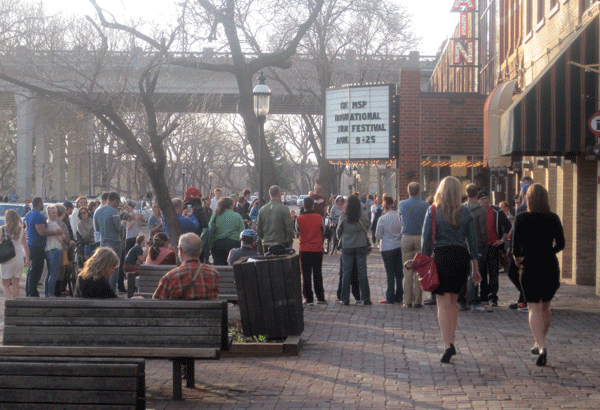
You can learn a lot about the Minneapolis-St. Paul International Film Festival just by striking up a conversation with the person standing beside you in line. That's because people who go to the fest usually go often. (If you wanted to see just one movie, you'd go to your local cineplex. No?)  So it isn't uncommon for a stranger standing next to you to ask, "What have you seen? What have you liked?"

That's how I found out about Tangerine, the best of the eight films I've seen at the festival thus far. It's a war film, but also an intimate drama. It takes place in a wooden valley in Abkhazia, a sub-region of the former Soviet Republic of Georgia. Georgia is now an independent state, but some of the residents of lower Abkhazia consider themselves more Russian that Georgian, and during the time the film takes place, they're fighting for their independence.


To complicate matters, the film's central character, Ivo,  is Estonian. Estonia is 1700 miles from Abkhazia, but during the nineteenth century many Estonians settled in Georgia. Now that Estonia is no longer part of the USSR, many Estonians are inclined to go home, and the fighting in Georgia provides an added incentive. But Ivo and his friend Margus have decided to stay on until they've harvested the tangerines. Ivo makes the crates, Margus picks the fruit. They've arranged for a local militia to escort the produce to the market, and even, perhaps, help them pick the fruit.

Their tranquil agricultural pursuits are shattered when a firefight takes place on the country road outside their farms, and Ivo finds himself taking care of two wounded soldiers, one Georgian, the other a Chechnian mercenary fighting on the side of Abkasia and Russia.


The Chechnian, Ahmed, vows to kill the Georgian, Niko, once he recovers from his wounds, but Ivo gets him to swear that he will kill no one within the house. Ivo is a man of his word, and so is Ahmed. Thus we witness two soldiers gaining strength day by day as they hurl insults (and sometimes hot tea) at one another at the kitchen table, waiting for the moment when they'll finally have it out.

Ivo is determined to bring these two soldiers back to health and defuse their animosity to one another.  And in time the situation within the house mellows, but things get more complicated as military patrols begin to show up, sometimes Georgian, sometimes Russian. "Who are these invalids?" they want to know.  Which one is the enemy?


Tangerines has been described as an anti-war film, but that's not the case. It's a drama about men getting to know each other in the context of homeland and religion, bravado and incipient violence, where the most thoughtful people seldom call the shots, and who gets hurt bears little relation to justice or right and wrong. 


La Sapienza

Oppositions abound in this didactic film set largely in Italy: male/female, rational/mystical, Bernini/Borromini, young/old. They're the stuff of drama, but also of cliché.


Here director Eugene Green keeps the drama to a minimum by forcing his actors to remain wooden in their actions and robotic in their speech. Every remark and gesture is followed by a long pause, people often look head-on into the camera. It might serve as a good instruction film for those learning to speak Italian or French. In short, the film is ridiculously stylized...but it's also sort of fun to watch. 

And moments of comic relief also crop up from time to time. The characters learn from one another, absorb the lessons of Renaissance Italian architecture, and loosen up, so that by the end of the film they're almost behaving like normal humans.


Green is better known for directing Baroque operas, where stylization is the norm. Seeing such things on the big screen without arias or orchestral accompaniment throws us out of our comfort zone and forces us to reflect a little more carefully on the few things that are being said, and the many things passing slowly in front of our eyes.
  
Sound of Redemption: The Frank Morgan Story

Heralded as "the next Charlie Parker" in the early 50s, alto saxophonist Frank Morgan took the path of heroin, bank-robbery, and thirty-years in prison. Here director N. C. Heikin tells Morgan's  story in jazzy style, with interviews of wives, fellow-inmates, family members, and fellow musicians.


Morgan comes across as a gifted musician and an irresponsible charmer who never believed he was as good as people seemed to think he was.    

A concert held in St. Quentin prison to honor Morgan's memory acts as the backbone to the narrative. Anyone who likes Bebop will like this film. Anyone who doesn't know what Bebop is should see it.

The director was present at the screening we attended, and also Frank Morgan's niece. Frank spent his last few years in Minneapolis, and she told us stories of how he would spend his days wandering the backyard, playing his saxophone.


Behavior

Behavior is a sprawling Cuban film about a young boy in Havana, life on the streets, dog-fighting, academic bureaucracy, and the challenges teachers face bringing along students whose home lives are a shambles. The tale is moving. The cinematography is stunning.  


Every Face Has a Name

The Swedish creators of this film, a sequel to Harbor of Hope, once again succeed in tracking down the people who arrived in Malmo at the end of WWII to start new lives. In comparison to the earlier film, it seems a little tired, a little uninspired. The stories are sadder, not because of the war, but because of who the individuals are.

Operation Popcorn


A documentary about Hmong leaders in Fresno, California, including General Vang Pao, who try to buy armaments to send to Laos. The dealings seem a little amateurish, the Hmong leaders don't seem to know what they're doing, and the film itself is short on visuals, but it's a mildly interesting story that exposes how loyalty to a home halfway around the world can really mix things up.

Medicine of the Wolf


Images of cuddly wolves and the eloquence of Jim Brandenberg cannot altogether obscure the fact that Julie Huffman, the woman who created Medicine of the Wolf, hasn't done much research on wolf management. Nevertheless, wolves are fun to watch and viewers may be inspired by the film to look more deeply into all the things that were never mentioned in the film.

Virtuosity


Competition films abound—spelling bees, opera try-outs, wine-tasting, dance contests. Here young  contestants in the Van Cliburn Competition in Ft. Worth, Texas, rehearse at the piano and discuss various aspects of their lives and music. These artists from Italy, China, Russia, and other places already know a great deal about career development and arts management, but their back-stories are only intermittently interesting. Fei Fei Dong, the young Chinese pianist, didn't come close to winning the trials, but she steals the show as the most sincere, sweet, and winsome personality in the group. 

As luck would have it, Fei Fei was in the audience for the event, and she and the film's producer shared some further anecdotes about making the film after the screening.

Thursday, April 16, 2015

AWP - Hanging Around the Booth


On the way back to the booth, I passed the table of Bad Penny Review. Those guys have been busy manufacturing little boxes filled with postcards, coasters, chapbooks and other printed material, and offering them for sale at very reasonable prices. (I would have bought one but it occurred to me I might just as well rummage a little through the drawers of my old desk.) 

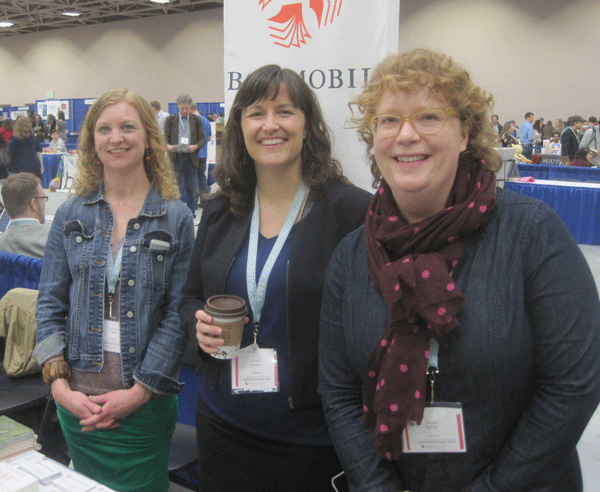
I also ran into my colleagues at Bookmobile, Gretchen Franke, Nicole Baxter, and Rachel Holscher. I had never met Gretchen though we've emailed many times. I recently sent her a note saying: "Ignore that last PDF I sent. Some additional corrections are on the way." She replied, "Thanks, John. I usually do hold your files for a few hours before running them. I've noticed that your 'last minute corrections' are seldom really the last ones you send." It's sad, but true.


It was a special pleasure to reconnect with Rachel. The last time we spoke face-to-face was at a printing workshop in Brainerd maybe ten years ago. At that time her kids were young and she was a worried that her camping days were over. I asked if she'd been doing any camping lately.

"Oh, yes. We go twice a summer. My children are both teenagers now. They like it--though they'd rather sleep in their grandparents' fifth-wheel than on the floor of our tent." When I mentioned that Hilary and I were contemplating a backpacking trip, she brought up Isle Royale, where she and her husband had gone on their honeymoon.

Hanging Around the Booth

But hanging around the booth can also be fun. I work with authors from Nodin Press fairly often, and then, following the intimacy and intensity of assembling a book together, they disappear. Or maybe it's me who disappears.


In any case, it's always a pleasure to reconnect with poets and historians I've worked with, and also with those I hardly know.  At various times I shared the booth with Freya Manfred, Kate Dayton (who has a wonderful hoot of a laugh, and lets it loose often), Norita Ditterberger-Jax, and Margaret Hasse (who brought me a ham sandwich on Friday after watching me eat a deep-fried chicken fillet sandwich from the concessionaire the previous day. Gee thanks, Ma!)

I had never met Joyce Sutphen, though her poetry figures prominently in the new Nodin Anthology. I got to talking with her when she visited the booth, and after I made mention of her poem about the scythe that appears  in the new volume, she said:

"Right now I'm memorizing a poem by Robert Frost called 'The Mowing.' I often drive to St. Peter to teach, and I have the text beside me on the car seat." And then she recited the entire poem to me in one of the softest voiced I'd ever heard.

There was never a sound beside the wood but one,
And that was my long scythe whispering to the ground...

It occurred to me only later that perhaps I'd now experienced the full decibel range of personal poetry recitation. Twenty years ago I ran into Robert Bly at the Blockbuster video store on Hennepin Avenue. Before long he was reciting a new poem he'd recently translated at the top of his lungs. Twice.

The point here isn't "brushes with fame." It's that people who love poetry and live in that world find it natural to recite poems to perfect strangers. I like that.

Joyce and I discussed the pronunciation of "scythe," and I confessed to her that the word "chasm" also troubled me. Was it "ka-sem" or "cha-sem"?

"I think it's "kas-em," she said, "but I haven't had occasion to say it very often."

Mike Hazard sauntered up with some poem-sticks in front of his face. I asked him what he'd been working on.

"Two days ago I finished my documentary about George Stoney," he said with a grin.

"That's huge," I replied. "You've been working on that for twenty years. Isn't he sort of an idol of yours?"

"Don't say idol," Mike corrected me. "Stoner was totally against idols." We chatted for a bit about Wiseman's recent film, National Gallery.

"That film was good," Mike said, "but it could have ended at any point. But all Wiseman's films are like that." 

Several people who stopped by were aspiring authors who told me stories of painful mental illnesses, autoimmune diseases, or of deaths in the family that were part of the memoirs they were writing and hoped we'd publish. Others had taken classes from Linda Back McKay, and were equally impressed by her motorcycle trips and her surreal imagination.


And my old buddy Glenn Freeman, who teaches creative writing at a small college in Iowa, stopped by early in the event.  He'd just attended a morning panel about funding college writing programs."Demand is up, funding is down," he told me. "At the panel a recent survey was unveiled that will help me convince the dean that my program is way underfunded."

Glenn and his wife, Mary Beth, had been over the previous evening for some impromptu catching up on the deck. I'd like to say we served them a fine platter of meze dishes, but the spread was actually concocted of odds and ends from the fridge. I guess that's more or less the same thing—sliced gruyere cheese, reheated ratatouille, cole slaw from CostCo, spanikopita from the freezer, and left-over quinoa salad with asparagus and mushrooms.

But the most surprising visitor to the booth was Tim McDonnell. The last time I saw Tim, he was a scrawny, sixteen-year-old pouring Swiss Miss from a box into small plastic bags. We worked at the same canoe base. He was the outfitter; I was a guide. In the forty years since then, Tim has lost most of his hair but grown a thick salt-and-pepper beard. Yet I recognized him immediately. He's still the same thoughtful, soft-spoken soul  that I once knew, and he's written a few books to prove it. He and his wife are both kindergarten teachers. "We love kids," he told me, "especially the ones that go home at 4:30."

Tim has moved on from canoeing, and now leads kayak trips in his spare time in Pukaskwa National Park, on a roadless section of the remote northeastern shore of  Lake Superior.

The Panels

The organizers of AWP winnowed down 1800 panel requests to a mere 550, but all the same, it's largely hit and miss whether you'll sit in on a good one.

I attended one devoted to non-fiction in the age of the internet, and the talks went like this:

A: I was suffering from postpartum depression so I started stalking my neighbor and made a video about it. It went viral, the text was included in a non-fiction anthology, and now I write a regular column for the New York Times.

B: Yeah, well I wrote a blog mythologizing myself, everything was true, but exaggerated, like me drinking from beer bottles that had been used as ash trays. I have done that - but not all the time. So you see, it's true, but not true.

Panel lesson number one: always sit near the door.

I attended another panel devoted to issues related to how "the past" can be used in travel writing. The first speaker, a professor from Chicago, used the F-word thirty times during her twelve-minute talk. It wouldn't have been so bad, except that the rest of her vocabulary was equally limited and cliché-ridden. Flaking paint in student apartments, etc.  

I felt sorry for her students and former students, many of whom were in attendance. But a woman who came by the booth later told me, "Her students love her. I thought she was funny myself!"

At another panel, I listened to a young scholar advance the argument that Paul Celan wrote poems that cannot be understood—on purpose. But everyone fails to understand Celan's poems in a different way, and the panelist made an attempt to describe how his failure to understand the poems differed from the mistaken interpretations of other scholars.

As I listened, I was reminded of the scene in Renoir's The Grand Illusion where one captive in a prison camp tells another that he's passing the time by translating Pindar. The first man picks up the book from the desk, then looks down at the translator's notebook, and says, "Poor Pindar."

On the other hand, listening to poet Tony Hoagland read for five minutes at a Greywolf reading was truly memorable. The words were thoughtful, the delivery restrained, the pacing perfect, the effect sublime.


I even served on a panel myself, doing my best to loosen up the crowd with a SNL intro to distinguished Nodin Press authors Lori Sturdevant, Jim Gilbert, and Margaret Hasse. The turnout wasn't bad, considering it was Saturday morning and people had already been there for three days.

And as far as I could tell, nobody slipped out early!

Sunday, April 12, 2015

A Surfeit of Creativity—AWP Arrives in Minneapolis


It's the largest literary conference in the US, and the numbers are impressive: 13,000 attendees, 550 panels, three hundred off-site events open to the public, 46 featured presenters (i.e. writers you might have heard of) and hundreds of booths on the Bookfair floor touting MFA programs, literary presses and journals, mainstream publishers, university presses, philanthropic foundations, printing services, and writing centers.

Convention A-B-Cs

I noticed that some of the exhibitors were very specific ornithologically—for example, Carolina Wren Press, Barn Owl Books, Carrier Pidgeon,  and Anhinga Press. Others had a gustatoral flavor—Black Radish Press, Chop Suey Books, Bodega Magazine, Carve. The geographic terminology extended far beyond the Ojibwe- and Dakota-esque nomenclature we Minnesotans are used to: The Chattahoochee Review, The Afgan Women's Writing Project, Black Mountain Books.

And then there are all the nutty names that might or might not meaning anything but are evocative, or make an impact: Action Books, Cardinal Sins, Alcamadus Press, BOMB Magazine, Antilever Press, burntdistrict, Area Sneaks, Bloof Books, Asterix Journal, Barefoot Muse Press, Cactus Heart, Barrelhouse, Bat Cat Press, Big Lucks, BookThug, Boulevard, Civil Coping Mechanisms.

I'm sure you've noticed that all the names I'm mentioning start with an A, B, or C—only a few of the exhibitors from that section of the alphabet, in fact. Multiply by a hundred and it will give you a fair idea of the enormous range of publications on display in the cavernous hall of the Minneapolis Convention Center.

I hesitate to call these publications obscure, considering  I don't know anything about the current literary scene. Conference attendees who are enrolled in MFA programs maintain a clearly defined hierarchy among them, no doubt, and a bevy of cliques and counter-hierarchies surely exist to sooth the egos and grease the career-paths of writers who haven't yet emerged on the top tier. More importantly, perhaps, these small-scale publications, based on the time-honored Shoot the Piano Player philosophy, "the shy can try," sustain a community of litterateurs  who are loyal to a lifestyle, a region, an aesthetic, or a small group of friends.


Attendees like me, who know nothing of this plurality of literary worlds, can't help but be impressed by the youthful energy and intelligence of those who fuel them. And also the artistry. I'm not referring to text so much as the manufacturing. Many of the chapbooks and journals I saw were beautifully made. Some were hand-tied.  
  
Wandering the Floor

The productions of Red Bird Chapbooks, a local group, stick in my mind. I was on the verge of buying one of their little pamphlets, Immanuel Kant vs. God, a 48-page erasure poem by a woman I'd never heard of named Lisa Mangini. And I couldn't help noticing the fine products of Ugly Duckling Press, a Brooklyn-based publisher that occupied the table next to ours. I was impressed by the steady stream of young hipsters stopping by their table to buy books and to chat.


In the center aisles near the door, local giants Greywolf, Coffee House, and Milkweed had set up shop in the vicinity of various university presses (Nebraska, Minnesota, Utah, etc.), East Coast organizations like Bookforum and the NEA, hallowed literary presses such as Copper Canyon, and writer's programs from Edinburgh, Surrey, and other far-flung places.

Everyone was eager to talk, though I found myself asking more questions about the landscapes than the literature, which was largely unfamiliar to me. I mentioned to the gentleman at Copper Canyon—one of the few people in the hall wearing a suit—that I'd stopped into their office at a state park outside Port Townsend, Washington, a few years ago.

"It was cool and foggy," I said.

"Gee, who would have thought?" he replied in a mildly sarcastic tone. "I hope they were cordial."

"Oh, yeah. We picked up a few books, including that thick volume of Machado, the Barnstone translation."

He nodded his approval.

"Have you been to any panels?" he asked.

"I'm going to one soon about something that wouldn't interest you, I suspect. Landscapes of the North Dakota imagination."

"Actually, I once bicycled across North Dakota," he replied.  

I had difficulty convincing the woman across the way at The New School, perhaps the most statuesque rep at the event, that her organization had been started to give employment for Jewish refugees from Germany during World War Two. (Perhaps because it isn't true. The New School was founded in 1919.)

"You know. Horkheimer, Adorno. I'm talking about the New School for Social Research," I said.

"I don't know about the Jewish element," she said. "And that's just one branch of the New School. There's a New School for design, for jazz."

Back at Versal (booth 536) I was entranced by a nice spread of novels in translation, though the only one I recognized was Elena Ferrante's Story of a New Name. The woman behind the table, Florencia Lauria, told me she had nothing to do with the press, but was standing in for a friend.

"Where are you from," I asked.

"I was raised in Argentine but I've lived many places."

"What are you doing here?"

"I recently graduated from the University of Minnesota's MFA program."

"Of course. I hear the people there are very nice."

"Yes, Patricia Hampl and Charles Baxter are very nice," and she grinned broadly.

I mentioned that I once met a woman from Argentina  whose father had been friends with the philosophers Julian Marias and Ortega y Gasset.

"I'm not surprised. In Argentine everyone lives in Buenos Aires, and they all know each other. My parents were friendly with Borges."

"But there must be a class element involved," I replied. (After all, everyone can't know everyone.)

"Oh, for sure. And we've had waves of immigrants. Italians. Then Germans. Recently it's other Latin Americans.

"The daughter of some friends of mine says that if anyone from Latin America starts to dance the merengue, she can tell in two steps what country they're from." She laughed.  

By this time in the day I'd talked to enough attendees to know that at a writers' convention, you don't ask, "What was your thesis about?" but rather, "Does your collection have a theme?"

"They're stories about Argentine ex-patriots. I got the kernel for some of them at an Argentine restaurant in South Minneapolis where I used to hang out."

"I remember that place. On Lake Street —"

"—No, it was on Franklin."

"Oh, yeah. South side of the street. I sort of wanted to check it out, but I didn't want to have a steak."

"Yes, we do eat a lot of meat." And she flashed another shy grin.

A few aisles away I came upon another literary goldmine—Archipelego Books. A book by Novalis caught my eye, with illustrations by Paul Klee.


"I just finished reading that," the tall young man behind the table said. "It's strikingly modern."

"Well, the German Romantics aren't fully appreciated today," I said. "They're far more surreal and metaphysical than their English counterparts. Have you read Pollen?" We chatted about Novalis and Frederich Schlegel, and I told the man—I never got a good look at his name tag—a story about trying to secure the rights to an image by Paul Klee for the cover of a book of poems I was designing.

"All the paperbacks are $10," he said. "And you can have these four volumes of Knausgard in hardcover for $40."

I shook my head. "I tried him but it didn't take. Do you like him?"

"Yes, I drank the Kool-Aide."

I left the table with three books in my hand: Ponge's Mute Objects of Expression, the Novalis book, and Time Ages in a Hurry by Antonio Tabucchi, which he gave me with the understanding that I might review it somewhere.

In the midst of the central booths, which were more substantial and had blue sheeting behind them, I came upon the New York Review. It recently issued a nice paperback reprint series of American, British, and European classics.

"I just ordered a few books from you guys," I said. "It was your half-price sale. The Halls of Uselessness, Onward and Upward in the Garden, Kabir's poems, and Sir Thomas Browne..." I paused, unsure of pronunciation, and he rattled off the title as if it were a single French word for a complicated sauce.

"You mean Religio Medici and Urne Buriall."

"Gee. That sounded convincing."

"I don't know if it's right, but what the heck. What did you think of Kabir?" And he flashed a sly grin.

"I'm not sure," I replied. "You're in Bly country here, I hope you realize ... They're certainly irreverent."

"Not your typical classical Indian poems."

As we chatted I became increasingly impressed by the rep's command of his list. He was very young, but anything I mentioned he seemed to have read. I pointed at Stoner, which was face-out on the table. "A Missouri literature professor?" That's all I could come up with.

"Correct." And he told me the entire story, nuancing it in such a way that he left me unsure whether, in the end, the man's life had been fulfilling or not.

"Well, now I won't have to buy that one," I said.

"No, I think you'd enjoy it. And I'm discounting everything."

I picked up a compact volume of Pierre Reverdry's poems with a stunning blue cover and said, "Rexroth did a good version of this guy's work many years ago for New Directions."

"I know. Some of those translations have been included in our little volume."

We had a chuckle over the fact that whenever you start talking about the New York Review of Books, people think you're talking about the much less detailed or informative New York Times Book Review.

Then I spotted the three volumes of Partick Leigh Fermor's narrative of his walk across Europe in 1933.

"Did you say you were giving some books away?" I asked disingenuously.

"No, I didn't. But I'll give you these for five bucks apiece."

"Sold."

Up next: the panels, the booth

Wednesday, April 1, 2015

Meeting the Hmong (in Saint Paul)


The current exhibit of Hmong history and culture at the Minnesota History Center in Saint Paul is both delightful and profound.

In the first of two rooms, we learn of the Hmong's traditional lifeways in the highlands of Laos and their contributions to the American war effort in southeast Asia during what is popularly known as the Vietnam War era.

Large video screens show us villagers hoeing fields on steep hillsides using hand tools, while other screens replay scenes of combat in endless tape-loops. Military uniforms are exhibited on the wall behind Plexiglas cases containing curved aboriginal multi-tube flutes. Other cases nearby recreate the mess of unexploded personnel bombs that still litter the Laotian countryside.

An attempt is made to outline the complex political environment of Laos, Thailand, and Vietnam during the mid-to-late twentieth century. The various maps and text may be difficult to absorb fully, but they serve as a refreshing corrective to the simple-minded view many of us grew up with regarding the course of events prior to and during American involvement in the region.

One thing is clear: the Hmong who fought against the communist elements in Laos in those days were fighting for their lives, and after the war, hundreds of thousands of them were executed by the Pathet Lao. A smaller number escaped to refugee camps in Thailand, while fewer still were granted refugee status in St. Paul, Fresno, and other cities throughout the United States.


The second room of the exhibit contains artifacts of Hmong life in the New World. In one video, a young woman describes how important  a tape deck was to her father; he used it to send audio messages to relatives in refugee camps back home. Traditional notions of portable wealth are also on display: bars of solid silver and appliqué necklaces fringed with small coins.

One kiosk explains differences in Hmong dialects and orthography. A low-hung poster lists the eighteen Hmong clans. Examining the list, I noticed the Her clan, and was reminded that not so long ago we bought a Toyota off the lot from a saleswoman named Yer Her.

One corner of the room is devoted to the Hmong's impressive contributions to local farmers markets and truck gardening industry. And the back wall is covered with video screens displaying images of Hmong MTV-style pop music performances, Hmong fashion-runway shows, and news broadcasts in Hmong from TV stations in California. Just wait a minute and you'll see men dressed in traditional garb dancing as they play their wooden flutes—a scene that morphs into a young man breakdancing.

I left the exhibit with a powerful if inchoate sense of heroism, sacrifice, hardship, loyalty, sweetness, and the simple enjoyment of life and family in a new environment.

Friday, March 27, 2015

George Morrison in Minnesota


George Morrison is well-known for his driftwood landscapes. There's a big one hanging at the Minneapolis Institute of Arts.  I've walked by it a thousand times, to the point where it strikes me as, well, a little dull.

But there's nothing dull about the retrospective of Morrison's work at the Minnesota History Center. The exhibit takes us from his decision as a student to switch from commercial art to fine art, drawn to the romance of being a serious artist, through years of abstract expressionism in New York and France, then back to Minnesota to teach at a time when Native American Studies was in its infancy as an academic field.

Work from each period draws our attention. An early landscape, realistic in the way that Marsden Hartley's paintings are realistic, gives us an animated impression of hills and fields in the vicinity of Grand Portage, where Morrison grew up.

Paintings and drawings from the time Morrison spent out East betray the influence of Kline and deKooning, though it strikes me that Morrison's abstracted forms from that period also bear a certain likeness to the stolid still-lifes of Giorgio Morandi.

Some of them also harbor elements of 50s kitsch, meaning, I guess, that the forms are pleasantly abstracted, rather than angrily torn or ultra-coolly lifted  from life. I kept thinking, "That looks like the cover of an Ornette Coleman album I used to have."

In the course of the 50s and early 1960s Morrison became fond of intense magentas and thick impasto, though one of my favorites from the period is a delightful mess of yellow and blue smears with a few black highlights. It might have been at this time that he began to make collages out of driftwood gathered on Atlantic beaches.

Though these wood collages have become Morrison's hallmark, I find them a little too smooth, cool, and calculated. The wood isn't really driftwood, so much as it's discarded lumber. Morrison has fitted pieces together ingeniously to establish knots of activity held in place by vertical and (more often) horizontal lines of weathered lumber. Alas, the overall effect is more calculated than natural. I get the impression machines were involved.


Even less interesting, to my eye, are the intricately patterned totems he built out of blocks of wood. The wood itself is polished, the patterns are graph-like, and they remind me more of corporate clientele than of natural spirit.

Late in life Morrison brought various elements from other phases in his career together in some of his best paintings—seascapes in glaring magentas and blues of the sort that haunt Monet's predawn paintings of Rouen Cathedral. But here it's just the horizon and clouds of color interpenetrating, breathing together. Like nature, yes, but the intensity comes from within.


The romance of the serious, genuine artist, seeing what's there and also what isn't there—seeing where things overlap and refuse to fit. Summoning a place, and an atmosphere. Wow.


Thursday, March 19, 2015

Poetry for a Spring Evening


There were spring-like overtones in the air last night at sunset, but not enough to keep me away from a reading at the Merriam Park Library of poets who've been published recently by Nodin Press.

The basement meeting room was packed—maybe 75 people— with chairs strategically positioned beyond several doorways. I'd gotten there late and looked ruefully at the last remaining cookie on the plate. (Of course I didn't take it.)

The event was sponsored by the Friends of the Saint Paul Public Library, and Alayne Hopkins, director of Friends' programming, buoyantly introduced the poets before each one took a turn at the podium. (Disclosure: I often work with Nodin Press and was involved in the production of all of the books involved in the reading.)

Jill Breckenridge read first, due to the spelling of her last name, and she was a good one to set the mood. She reminded us with a wry look on her face before she'd uttered a single word that poetry can be wise and fun at the same time. Though I can't claim to remember every poem that she (or any of the poets) read, she shared a good three-line poem about aging and a longer one about accidentally attending a party in her black Cuddl Duds.

Norita Dittberner-Jax read next, exploring a slightly more meditative vein. In one poem she described the mood of a different era, when the war in Vietnam was on the news and her children were very young. Before reading a second poem, she said, in a quiet voice, almost to herself: "I've been thinking a lot about trees lately."

Now, if we were at a meeting of the Parks and Trails Council, that remark would be followed by some sort of recommendation for planting trees, or cutting down trees, or caring for trees. Then again, in a psychiatric setting, the remark might lead on to considerations of the proper medical prescription and dosage to get those tree-thoughts under control.  

But in a poetic context, instrumental reason (as the philosophers say) gives way to other modes of thought.

I, for one, knew exactly what Norita was talking about. I think about trees myself—not what to do with them, but about the trees themselves: their presence, their grandeur, their quiet durabilty, the differing character of the mulberry and the beech, and so on.

But if I remember correctly, the poem wasn't about any of that. The speaker was sitting under a tree, at a cafe, listening to snatches of conversation as people passed, appreciating all the snippets that were contributing to a stunning moment ... and praying that no disaster strike to puncture the moment. But the pray was not for herself. It was for the world, and the passing people, and the  trees.

I suddenly had the feeling that I was at Quaker meeting, where all is silence until someone, moved by the "inner light," stands up to speak. The difference, of course, is that the poems being read had been conceived long ago, then polished and improved upon. Yet the spirit in the room was very similar, and no one in the audience, I think, would have had the slightest difficulty accepting the notion of an "inner light."

It's a remarkable thing when people, many of whom don't know each other, get together and share lives.

Michael Kiesow Moore read next. I suspect he uses the middle name to differentiate himself from the documentary filmmaker Michael Moore, though after listening to him read, I began to wonder if perhaps the two are related. Both feel compassion for the underdog and express it eloquently. But Michael K. also has other interests in mind. The first poem he read, which might have been called "Stepping Through the Shaman's Door," was a poetic invocation to trust our intuition. He had the crowd laughing uproariously with another poem describing what life would be like if introverts ruled the world.

Carol Rucks made use of her time behind the podium to give us the flavor of growing up in a Roman Catholic family of twelve where the paterfamilias was strict with his children but easy on himself. She made it clear she has lots of vivid memories roaming around inside her head, but has transformed them in ways that shine new light on the enigmas of growing up. (If I could describe it better, I guess I'd be a poet myself.)

To the bubbly Dara Syrkin was given the challenge of reading a representative sampling of poems from the forthcoming Nodin Poetry Anthology.  The poems were interesting, though at this remove I can only remember two. One related a dream in which the speaker assumes the personae of all the characters in The Wizard of Oz by turns. The line I remember is "I'm always too quick to trust the loudest voice."

I also enjoyed Dara's own whimsical poem about dating gladiators, then deciding to get a chariot for herself.

The last poet on the program, Greg Watson, was fighting a cough, but we wouldn't have known if he hadn't apologized for the cough drop in his mouth. He read one poem ostensibly found in the sleeve of an old 78—I remember the image of the vinyl discs dropping down the spindle, from the poem, and also from life. Another poem had the evocative title, "Let This Wine be the Night." Greg's images often morph in unusual ways without dispelling the mood or losing the thread. He can be describing something romantic and evidently concrete—and then it's not.

The entire evening was going that way for me, but in reverse. I'd been taken in quite a few directions— stimulated, delighted, anguished, or enthralled—and now I was back home in the library in the midst of a room full of thoughtful people.

Publisher Norton Stillman made a little speech before the event broke up, expressing how much he values the personal friendship of the authors he works with. I've worked with Norton for years and I have seen that this is true.

I enjoyed saying hi to Carol Connolly and Ted Bowman. My old buddy Don Ladig (no slouch as a poet himself) was there; his knee is healing nicely. And I chatted at length with poet Kate Dayton and her husband Joe about the Northern Lights, the flowers in the desert south of Palm Springs, and other important stuff. 

As people were leaving and chairs were being put back in the closet after the event, I butted cordially into a conversation between Michael Moore and Linda White. It occurred to me only later that I was exhibiting all the hallmarks of those extroverts that Michael has grown more than a little tired of over the years.

But based on the humor and insight conveyed by his poems, I'm pretty sure he's already forgiven me. 

Thursday, March 12, 2015

Knausgaard Comes to Minnesota


Travel writing tends to be a litany of clichés and misapprehensions, but if the prose is sprightly and the impressions are fresh and vividly rendered, no genre is more fun to dip into. In any case, if we haven't spent much time in the places involved, we hardly notice the lack of depth and social insight. What's being described seems a lot like what we'd probably see if we were there.

Some travel writers know the regions they're describing well, of course. Lined up on my conceptual bookshelf of personal favorites are Michael Jacobs' books about Provence and Andalusia, H. V. Morton's classic descriptions of Italy and Spain, Lawrence Durrell's book about the Greek islands, and Norman Lewis's books about the Costa Brava and India.

Recent classics that leap to mind are Adam Gopnick's Paris to the Moon, Ian Frazier's Great Plains, Chris Stewart's Driving Over Lemons, Tom Piazza's Why New Orleans Matters, and Robert Sullivan's Cross Country.

When foreigners come this-a-way to offer their analyses of American life, things get a little dicier. Everyone quotes the nineteenth-century French observer Alexis de Tocqueville, and with good reason. Many have followed in his footsteps, Bernard Henry-Levy being among the most recent I can recall.

But modern-day visitors from abroad tend to search out the freak shows and truck stops, ghettos and reservations, Portlandias and Peorias. I guess that's where the stories are. But is that "America"?

On a Greek ferry heading to Santorini I once struck up a conversation with a young Swiss couple who'd been traveling the world.

"Are the small towns of America genuinely interesting?" the man asked me, with a good-natured but doubtful look on his face.

I thought for a moment before replying, "Not really."

Hey? What about Oxford, Mississippi? Taos, New Mexico? Point Reyes Station, California? Thermopolis, Wyoming? Cedar Rapids, Iowa? Price, Utah? Bayfield, Wisconsin? Bardstown, Kentucky? Stonington, Maine? Ste. Genevieve, Missouri? Durango, Colorado?

Yeah, well, you've got a lot of driving ahead of you.

*   *   *

The New York Times recently commissioned Norwegian novelist Karl Ove Knausgaard to take a driving trip from l'anse aux meadows in Newfoundland to Alexandria, Minnesota (the home of the Kensington Runestone) and write about the experience. It must have been a spur-of-the-moment commission, because Knausgaard didn't have time to do the slightest bit of research. In fact, he didn't even have time to renew his driver's license. I wouldn't have expected the rugged, chain-smoking Norwegian to make excuses, but he blames it all on a stressful Christmas.

As a travel piece, Knausgaard's account is worth little. He knows nothing and he sees nothing. His only connections to America seem to be musical—the blues and Kid Rock. He's read the Icelandic sagas but even when staring at archaeological remains of the Vikings' presence in North America he can't shake the notion that the tales are literary fabrications.

Knausgaard did go to the trouble to look up the Kensington Runestone, allegedly left by Vikings in what is now western Minnesota back in the fourteenth century. But it's evident he didn't read much of the Wikipedia entry he consulted. He seems to think they arrived in the Red River Valley by way of Cleveland.

" If the Vikings really had left their settlements up in Newfoundland and explored the continent by following the rivers and lakes westward, as the Kensington Runestone’s presence in Minnesota suggested, it was in a world completely different from the one we drove through. [Really? No shopping malls in fourteenth-century America?] I tried to imagine it, tuning out the sounds of the highway, the speed of the car, the concrete and the steel, but the place I then envisioned, a landscape untouched by man, was far too romantic to be true."   

Though Knausgaard is shy and doesn't like talking to strangers (not a good trait for a travel writer, I'm afraid) he finally connects with a long-lost cousin in North Dakota. From there it's a short jaunt down the freeway to Alexandria and the runestone museum.

He feels nothing in the presence of the stone itself, though he delivers the best line in the 20,000-word essay in response to it.

"I walked around it a few times, noticing that the inscription ran on, around one side. The runic inscriptions I had seen earlier, back home, were all short and pithy, whereas this was practically a novella."

But his response to the museum is entirely different.

The striking thing was how modest it all was, how insignificant the objects that were meant to represent the country’s entire momentous history turned out to be. How clumsily the paintings illustrating the various epochs were made. How awkward the overarching Viking theme was, from the winged helmet of the giant statue outside that beckoned to visitors, to the attempts to substantiate the theory that the Vikings actually came here, before any other Europeans, in the 14th century.
Yes, there was something homespun and makeshift and, frankly, childish about the whole thing.
And I loved it.
Knausgaard loved the museum because it cut America down to size. Though it was promoting a myth, it was a little one, and not the grand myth of America's exceptionalism. And it was promoting that little myth with domestic artifacts hardly different from the ones Knausgaard grew up amid.
It was liberating to see how small and insignificant each separate part of this history was, compared with our notions about [America's] grandness. It felt liberating, because that is what the world is really like, full of insignificant trifles that we use to blunder on as best we can, one by one, whether we happen to be 19th-century immigrants building a log cabin in some forest glade, cold and miserable, longing to sit motionless for a few hours in front of the fire; or a local museum director in a Norwegian children’s sweater; or a crafty Swede, carving runes into a stone and burying it in a field in an attempt to change world history.
Knausgaard had blundered on across America, taking baby steps and smoking cigarettes and looking out the window of a car he was reluctant to drive—because it had an automatic transmission! His observations are too often self-referential and almost invariably banal, but an element of defiant honesty somehow saves him in the end.

Last on his list of trifles that make up the life we live is "an inept Norwegian writer who has spent 10 days on assignment in the U.S. without discovering anything, apart from this."

*   *   *

Though I'm hardly an expert on Scandinavian-America travelogues, a few titles I've found illuminating over the years are On the Viking Trail: Travels in Scandinavian America, by Don Lago; Knut Hamsun Remembers America: Essay and Stories; and The Unknown Swedes: a Book About Swedes and America, Past and Present by Vilhelm Moberg.