Monday, August 22, 2022

A Visit to Rural Japan


A visit to the current show at the Minneapolis Institute of Arts, "Dressed by Nature: Textiles of Japan," may bring a wide range of thoughts to mind. At least, it did to me. The title refers to the fact that the robes, vests, shoes, jackets, hats, and ornaments on display have been fashioned making use of materials harvested from the fields and forests roundabout. Then again, silk is made by worms and derived from mulberry trees. But there are no silk garments included in the show, as near as I can recall.  This suggests that we need to emphasize the close connection between environments, communities, production, and use. It is that proximity which makes the focus of interest so attractive.


The chief draw of the show is the beauty of the garments on display. But on small video screens positioned throughout the exhibit, we can watch, for example, villagers out in the woods stripping the inner bark off of elm trees. They then scrape this "bask" with various tools to separate the finest and most delicate strands, which they then nimbly tie together into long strands. (I wouldn't want to do it.) These strands are then spun into thicker, stronger, and more uniform threads before being strung up onto the looms on which a particular fabric is woven.


Well, I guess this in the way most cloth is made, in one way or another. But the absence of heavy machinery, and the fact that the people making these clothes will be wearing them in ceremonies and also out in the fields, appeals to our atavistic, 1970s, back to the land, North Woods aesthetic.

Other mini-documentaries are devoted to the production of indigo dye, and yet another depicts a sophisticated wax-resist method of dying cloth

And did I mention the variety and beauty of the fabrics and garments on display?

Years ago, and not for the first time,  I stepped into Indigo—a shop in the warehouse district of Minneapolis that traded in folk art from Africa and Asia. At the time Nodin Press was located in the same building, right across the lobby. John and Mary owned the shop. I mostly saw Mary off taking their Airedale for a walk. John was behind the counter. They used to stock utilitarian bowls from the Machiko kiln in Japan, and we bought several; they were among the few items in the shop we could afford. (I used one of those simple but elegant bowls tonight, forty years later, to make the salmon spread we're having for dinner.)

 Maybe they still do stock those bowls, though they moved their collection to NE Minneapolis when their very attractive long-term lease (signed in the darkest days of the pre-yuppy warehouse district decline) was up. They could no longer afford the rent in that location, and besides, by that time, so many of the warehouses had been converted to high-end condos that there was no longer any free parking to be had nearby.


On that bright morning I spotted a pale blue Japanese vest on a table. It looked like a small rag rug with sleeves. I was on the verge of trying it on when John, kindly as always, spoke up from behind the counter: "Er, that's a collector piece."

I knew what he meant. Something to be hung on a wall, not worn all day in a rice paddy. And more obliquely, something probably couldn't afford. Sure. I understand. No offence taken. Because what John had said was true. Ragstock was three blocks down the street, out near the Salvation Army and the garbage burner. But I was in Indigo.

And now here I was, standing amid a large, impressive, and well-interpreted multi-room display of such garments. It was grand.


Throughout the exhibit, I found my thoughts drifting in the direction of concepts like "pattern" and "fiber." Yes, vocabulary is destiny. The origin myths of many cultures, including the Hopi and those of the Indus valley, if I'm not mistaken, are tied up with notions of spinning and weaving. We look for fiber in our diet, but do we look for it in our conduct? In our lives?


Maybe that's why young people of my generation were so enamored of jeans. One thing the exhibit makes very clear is that as far as tie-dying is concerned, the rural Japanese surpassed the hippies by light-years. 


One garment on display that appealed  to me especially carried images of a few big carp. I thought this garment might be appropriate for me to wear when I go down to Bassett Creek to measure the water clarity. There are often a few big carp swimming around just upstream from the bridge. This presents a challenge to the researcher because when the carp sees the yellow bucket being dropped into the water from the bridge, he swishes his tail in an effort to get away, thus raising a huge cloud of debris off the creek bottom, and that skews the measurement.


Another attractive aspect of the exhibit was the emphasis on islands. Japan is a nation of more than 6,000 islands, and those pockets of isolation foster native arts and regional idiosyncracy. The Ainu of Hokkaido in the north will be wearing robes made of thick leather and sturgeon skin while the denizens of Okinawa, two thousand miles to the south, are wearing airy clothing woven of wisteria reeds.   


It was just our luck that a guided tour came by while we were at the show lead by the curator Andreas Marks. His tone was bright and his anecdotes were pithy, both of the garments themselves and the adventures of the connoisseurs who had collected them. And there is something charming, and  also strangely ennobling, about listening to a man with a German accent, in the middle of the North American continent, share his knowledge of the banana-peel cloth crafted on remote islands of Japan 


After viewing the show, Hilary and I had lunch on the terrace at the Longfellow Grill. I ordered the seared, sesame-crusted yellowtail tuna salad, with spinach, mixed greens, blistered tomatoes, cucumber, green onion, ginger wasabi dressing, peanuts, and citrus unagi. You can see why.

Later, back home, I pulled a few books off the shelf: Memories of Silk and Straw: A Self-Portrait of Small-Town Japan (c. 1987) and The Kimono Mind: an Informal Guide to Japan and the Japanese, by the iconoclastic architect and cultural historian Bernard Rudofsky (c. 1965). I couldn't locate our copy of  The Unknown Craftsman: A Japanese Insight into Beauty by Yanagi Muneyoshi (c. 1972).

In case this all sounds a little out-of-date, well so are the folk robes of Japan. And let me assure you that in preparation for our visit, we spent several evenings watching the cutting-edge, more than slightly vulgar and outrageous, six-part Amazon Prime series James May in Japan.


Friday, August 5, 2022

Hunt Hill Audubon Sanctuary


Our recent midweek visit to Hunt Hill Audubon Camp, an old farm that's been turned into a nature preserve twenty minutes east of Shell Lake, Wisconsin, was chock full of low-key events, which was just what we were looking for. The farm was purchased by a wealthy Minneapolis grain merchant a hundred years ago as a family getaway, and they built two modest cabins in the woods that you can now rent through AirBnB. The sanctuary today includes nearly 600 acres of woods and restored prairie, 13 miles of hiking trails, a few small ponds connected by a stream, and  a residential campus for environmental learning programs.  

The cabins are situated in deep woods at the top of a ridge, and from the small front yard of the lower cabin you can see only a hint of blue water far below through the trees. I can easily imagine someone checking in, oohing and aahing at the big stone fireplace and the wrought iron door hinges,  looking around for a few minutes, and saying, "Well, what are we supposed to DO here?"


One thing you can do is sit in a chair and look up at the trees, admiring their branching structure, while listening to the birds sing. It's getting late in the summer for that kind of thing, but throughout our stay we heard eastern wood pewees, red-eyed vireos, yellow-throated vireos, and chickadees, spiced up on occasion by sandhill cranes passing low overhead, a distant loon, or a lonely barred owl.

Of course you could read a book. I had brought along a book about the pre-Socratics, but the subject seemed out of place in such a verdant environment. (The North Shore would be better.)  I turned briefly to the Tang poet Du Fu and was soon inspired to write something of my own—the shy can try:

Wind rustling through the trees.

It's the loveliest sound on earth

on a hot August evening. Or can be.

Rising and falling. Here. Now there.

We wait for it to send that cool

air down to us.

And a pewee calls from the forest,

high-pitched and hopeful.

Nesting is over.

What is he yearning for?

Once we'd been settled in for a while, I said, "Let's go down to the lake." I'm sure Hilary was delighted to hear that, because I was nursing a sore leg and she had no idea how much hiking I would be able to do.


As we wandered down the leaf-covered path, we passed interrupted ferns, sensitive ferns, ostrich ferns, maidenhair ferns, and a diminutive species with delicate, almost feathery fronds that we named "delicate fern." At the waterfront there was a small sandy opening, not worthy of being called a beach, with a mass of purple pickerel weed growing nearby. Continuing down the trail, we reached a point along the shoreline from which we could see the quaint wooden bridge, but it was still a few hundred yards away.

 "I don't want to walk that far," I said. "Maybe tomorrow."

Hilary managed to pick four blueberries during our hike, about the size of BBs, which she shared with me. Were they good? Not really. But they were blueberries.

And to our surprise, as we stood looking away from Big Devil Lake into the marsh, we spotted two immature warblers—a yellow and a chestnut-sided.

The next morning we ate breakfast with some friends at their nearby cabin. After he retired Jim built a gorgeous wooden rowboat in his garage in St. Paul, and we went out in it together briefly. (Starting to contemplate my next book, maybe halfway between  "The Old Man and the Sea" and "Three Men in a Boat.")


We sat around chatting for a while, then we all returned to our place so we could show them the cabin interior.

In the afternoon a woman arrived to stay at the second cabin, which sits mostly out of sight farther up the hill. I spotted her through the window, and when we saw her again in the parking lot down at the main camp I said, "Aren't you the one staying at the log cabin?" We introduced ourselves and soon learned that we live not more than half a mile apart here in Golden Valley. She had a collapsible kayak in her trunk and was looking for the waterfront. We were headed that way, too, and she came along.


A few hours later she stopped by our cabin; we'd offered to show her the interior. "I kayaked the stream all the way up to the bridge," she said. When we went inside, she said, "Wow, this is spacious. It would be a good rental for a family." 

Pause. "But my kids aren't much into the outdoors."

"How about your husband?" I said.

"Him neither." Yet she had a fold-up kayak in her trunk. She wasn't complaining; she was exploring.

The next morning after breakfast—a reheated plate of rainbow trout and potatoes from the previous evening— we headed out early along a trail running between woods and field. It had rained during the night, with ear-splitting thunder, and in the glancing sunlight everything looked moist and gorgeous. At one point on the trail, as it knifed through some thick underbrush above a swamp, we flushed a mid-sized bird.

I knew immediately that it wasn't a grouse. The BRRRRRing sound it made as it flew up was only half the weight that a grouse would make.

"How about a baby grouse?" you say. No. I've flushed lots of baby grouse over the years, and they're always in large groups, football sized, with mama somewhere nearby.

Besides, I saw the bird's long, narrow beak during the instant that it was visible, flying off directly ahead of us along the trail before ducking for cover again.

I knew instantly it was a woodcock. A look at the bird guide back at the cabin later only confirmed the i.d. "Uncommon and inconspicuous on damp ground under dense cover within woods...Secretive and solitary; rarely seen in daylight...Wings produce a sharp twittering on takeoff."


The trail we were on led to a second bridge, but once again, we didn't quite get there. The trail was closed due to erosion. But you can see what an enchanting place this is to wander around in, like a Chinese painting come to life.( In fact, there's something appealing about those picturesque bridges you never quite get to.)


We spent some time out in the sunny fields, admiring the cone flowers and the pearly everlasting. And back in the parking lot we ran into a member of the staff.


"I love this place," he told us. "I retired from my regular job a few years ago, but I said to my wife, 'If a part-time maintenance job turns up at Hunt Hill, I think I'd take it.'"


Before heading for home we took one final trip down through the woods in front of the cabin to the big lake, and this time that bridge didn't seem so far away. When we got there, we even took off our shoes and wadded up the sandy-bottomed stream to get a better look at the pickerel weed.


Thursday, July 28, 2022

A New Perspective


I attributed the sudden jolts of pain I was feeling to a flurry of semi-strenuous biking, first through the fields and woods at Elm Creek Regional Park, and a few days later down the big hill on Wirth Parkway, around the pavilion at Wirth Lake, and back. Nothing out of the ordinary, yet a few minutes after that second ride, I felt a horrible pain deep in my upper leg, hip, or gluteus maximus—I'm no expert in anatomy. It jabbed me so fiercely that I couldn't put any weight on that leg at all. When I adjusted my posture slightly, the pain vanished. But avoiding that particular flex of the joint made walking very difficult.  For the last four or five days I've been going heavy on the ibuprofen, wearing muscle-relaxing menthol patches, and walking around hunched over like an old man, grabbing onto every chair and counter-top I can find.

In fact, I haven't been walking around much at all.

I spent the morning Sunday, when the jabs were at their worst, sitting in my portable camp chair out on the deck in the cool crisp sunny air, which had been refreshed by the previous day's rains.  Seeking a position of maximum shadow, I chose a spot on the deck where I'd never sat before, on the landing heading down the steps to the yard. It's a silly place to sit; the landing is only three feet square. But I found that from that perspective the neighbor's houses are entirely blocked from view by foliage, which is nice, and I'm also much closer to the greenery in the yard. You can't see the garden from here, but that's also nice. It looks pretty ragged these days, and also somewhat chomped down by the deer and rabbits.


Yes, the ligularia are blooming now, but they're less robust than they were a few years ago. We seldom fertilize, and two years of drought have also taken their toll. Maybe that's just the way of all plants—to lose their vigor and peter out.

One further virtue of this spot was that it afforded a view of both the trees and the sky in roughly equal measure. At one point I looked up to see a tiger swallowtail fluttering amid the highest branches of the silver maple that dominates our back yard "woods," moving at remarkable speed in a seemingly random series of sudden lurches without crashing into anything.


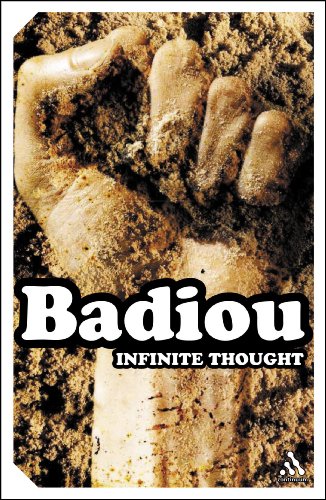
On a little table at my side were three books: a collection of essays by the French philosopher Pierre Badiou called Infinite Thought, a very short book by the nineteenth century novelist Alphonse Daudet called In the Land of Pain, and a book by art critic Jed Perl titled Authority and Freedom. I might almost say that I chose them at random, but you know as well as I do that isn't how it works. No. You comb the shelves looking for something to read and this or that title "jumps out" at you. You "respond" to it. "Yes, this is the perfect thing," you say. "If not for ever, then at least for right now."

Only time will tell. But exploring such affinities is what keeps life moving ahead,  enriches us, and, yes, makes us happy.

On page two of the introduction to Infinite Thought I hit upon an interesting passage. According to the commentator, Badiou divides life into two realms, ethics and truth, and further subdivides experience into four spheres or categories—art, love, politics, and science. This scheme resembles that of the Italian philosopher and statesman Benedetto Croce, who divides life into thought (truth) and action (ethics). Croce's more detailed set of distinctions includes four "moments of spirit," each of which corresponds to a value—beauty, truth, utility, and goodness.

I have little doubt that Croce's handling of these concepts is more rigorous than Badiou's, but the Frenchman might turn out to be more fun to read, and his points of cultural reference will undoubtedly be more up-to-date. Glancing at the index, I noted that Badiou never mentions Croce, though he does refer to Wes Craven, a film director best known for Nightmare on Elm Street.

The trouble with such ad hoc reading programs is that I seldom get very far. The sky had gone to a gauzy gray, the neighbor's wind chimes started acting up, a robin began to cluck, and a chuckling goldfinch began to circle the neighborhood. Soon a great-crested fly-catcher arrived in the neighbor's yard. I didn't see him, but I could hear his defiant war-hoop.

Foregoing the translator's introduction, I opened one of Badiou's essays and soon came upon the following remark:

"Every truth that accepts its dependence in regard to narrative and revelation is still detailed in mystery; philosophy exists to tear the latter's veil."

For myself, I'd be content to stick with the narrative and revelation. Such devices or vessels "hold" the truth quite well, and it's much easier to drink from them.

So I turned to Jed Perl's defense of the arts, Authority and Freedom. But I couldn't help asking myself, "What is Perl defending art against?" In any case, authority and freedom make odd bed-fellows. Artists are basically free by nature—aren't we all?—and they've never been much concerned about authority. It's the critics and historians who want to assert their authority, struggling to establish or defend a canon, and so on.

It occurred to me that Perl seemed to be treading a path laid out long ago by T.S. Eliot in "Tradition and the Individual Talent." Which I have never read.

Off to the bookshelves I went to fetch a book of Eliot's essays. My collection didn't have that essay, but "Notes Toward a Definition of Culture" caught my eye, and thumbing through it out on the deck I came upon a few nuggets of wisdom.

"The pursuit of politics is incompatible with a strict attention to exact meanings on all occasions."

"Culture is the one thing that we cannot deliberately aim at. It is the product of a variety of more or less harmonious activities, each pursued for its own sake."

"One symptom of the decline of culture in Britain is indifference to the art of preparing food. Culture may even be described simply as that which makes life worth living."

"What we believe is not merely what we formulate and subscribe to ... Behavior is also belief ... Even the most conscious and developed of us live also at the level on which belief and behavior cannot be distinguished."

Eliot's analysis is unequivocally a defense of Christianity, but he is so careful to discount anything that smacks of peremptory theology, empty piety, or mere ecclesiastical display that his argument, such as it is, begins to take on a Zen-like air, as in this elliptical remark:

"The way of looking at culture and religion which I have been trying to adumbrate is so difficult that I am not sure I grasp it myself except in flashes, or that I comprehend all its implications ... It holds good only in the sense in which people are unconscious of both their culture and their religion."

Thus did I wile away the day, almost as if I'd been at a cabin staring out at the boundless horizon of Lake Superior. Hilary joined me often, knitting at the table at the other end of the deck, and sometimes heading down into the yard to pick up sticks or tend to some ailing plant. Late in the afternoon we went inside to cook up some Thai meatballs, though standing upright long enough to mince two or three cloves of garlic was all I could do the contribute.


We got the meatballs out of a bag in the freezer, which moved things along. The sauce consisted of a potent mix of hoisin, rice vinegar, chili-garlic sauce, oyster sauce, fresh ginger, soy sauce, balsamic vinegar, and quite a bit of brown sugar. The recipe, though Asian in flavor, came from a cookbook written by a woman from Bayfield.

Saturday, July 23, 2022

Here's That Rainy Day


It's a song from the postwar period, I think. It starts like this:

"Maybe I should have saved those leftover dreams

Funny but here's that rainy day" 

The song is a lovelorn lament, of course. But I was looking forward to the rain, and so was everyone else. We were long overdue for a hearty soaking. Severe thunderstorms were predicted here and there, but for the most part just a gray, wet Saturday afternoon—the perfect time to hole up with a book that I might otherwise have returned to the library, unread.

But now one of my own "leftover dreams" resurfaces. It came to me as a book caught my eye that I'd purchased recently at Magers & Quinn —The Substance of Style: How the Rise of Aesthetic Value Is Remaking Commerce, Culture & Consciousness. I haven't read it cover to cover--haven't read it much at all--but the gist of it is pithily summarized by Steven Pinker in one of the blurbs:  "A brilliant analysis of a major new phenomenon: that people care more about how stuff looks." The book came out in 2003, the pages are yellowing. (I only paid a dollar for it.) But I thought it might offer an interesting snapshot of the era when people were first seduced by the sleek lines and high density plastic of Apple products, for example.


But is this anything new?  For the last forty years at least, some segments of the population have been avidly buying and selling "vintage" artifacts from the 40s and 50s. Evidently that era has a style of its own—maybe three or four. Further examples—deco, art nouveau, Arts and Crafts—could be adduced ad infinitum.

The author, Virginia Postrel, knows this, or course. She knows quite a bit about the history of industrial design, and the efforts made by crafts people and designers to beautify things prior to our consumerist age. But she's driving at a different point:

To say that the 1920s were an age of aesthetics is true in some sense, just as it is true that the 1850s were an age of telecommunica­tions, thanks to the telegraph, and the early 1960s an era of comput­ers, thanks to the mainframe. But everyday life feels very different when such developments are still mostly the province of a knowl­edgeable or wealthy elite. Pervasiveness matters.  

But are the things on sale at Walmart today really that much more attractive than what we find in a Sears catalog from 1902? Maybe not. In any case, it's clear that Postrel is far more interested in those styles that are supported by the expanding affluence of the later twentieth century than in aesthetic values per se. We might "like" the toaster or vase we just bought at Target or Pottery Barn or Conrans, but would anyone actually call it beautiful?

Maybe what intrigued me about the book was simply the association of the two words in the title, style and substance. They usually stand opposed to each other. One is by definition something solid and even weighty, while the other is almost by definition superficial and flighty. "Oh, that is SO last week!" as the saying goes.

In the midst of this train of thought I was reminded of a drawing class I took as a freshman in college. The instructor, Tom Eggerman, required that we read an essay by the artist and illustrator Ben Shawn called "The Shape of Content." I don't remember what Shawn wrote, but I do remember that Eggerman, with his bald head, wry sense of humor, and thick, sandy mustache, gave the game away in class when he said: "The shape of content is form. Isn't that a great formula?"


The substance of style? The shape of content? Even the concept of form leaves open the question of good form versus bad form. Classical simplicity or baroque excess? We're getting a little metaphysical here, which is fine by me. But beyond the demographics of marketing strategies and style trends lies the work of art itself, beautiful and unique, elusive and inexplicable. 

How do we recognize it? We feel it. It captures, in one way or another, the spirit and truth of the life we're living, without actually giving it a name.

The afternoon storm turned out to be mildly thunderous but intermittent—patches of moderate rainfall but no thrashing trees or upturned trash cans. During the heaviest cloudburst the sun was actually shining across the street.

The plants are happy, no doubt. But I was hoping for a little more darkness and drama. (Am I longing for winter already?)

At one point I picked up a slim volume of poems by William Matthews and read one in which he describes golfing with his father, who is stung repeatedly by a swarm of wasps, but insists on completing the round. 

The last stanza goes like this:

I played to keep my father company.

"They're cells. The nest is the real animal."

I pictured their papery cone and tried

to think what the dark surge wasps pass from each

to each inside might be except the fierce

electricity of state, or family.


Thursday, July 14, 2022

Bastille Day Meditations


There are times when things just fall into place, like the tumblers in a lock. You don't really have a key, but a rosy weekend opens to view nevertheless. 

Last Thursday night,  having consumed a hearty serving (or two) of chicken tagine with sliced lemons on couscous and a glass (or two) of côte du Rhone, while listening to a jazz trio called Tethered Moon perform a six-minute rendition of Edith Piaf's "L'accordíoniste," I was struck once again by the beauty and richness of the world we live in. Bastille Day is dedicated to such feelings, though  this year it almost escaped my attention. 


I know what you're going to say. "Beauty? Richness? Don't you follow the news?" 

To which I would answer, "Sometimes, but not always, and especially not on a weekend like this one."

Like everyone else, I'm aware that people are dying in Ukraine, while also staunchly defending their freedoms, supported by the US and the European community. I'm aware that inflation is at a forty-year high, though I also remember that moment, forty years ago, when Hilary and I bought a house with a fourteen percent reverse-mortgage interest rate. Somehow the world kept spinning and things worked out.

(I'm also aware that on Thursday the markets shrugged off the bad inflation news, and that sounds like good news to me.)

In any case, on Bastille Day, we put such things as real estate and market trends, and even the horrors of war aside. I'd rather read about the mustard shortage in France.

We sit in awe of the photos transmitted from the James Webb telescope, while also noting that they look a lot like scenes from Star Wars films. Yes, I know. These are real, in a manner of speaking, and scientists are going to learn a lot from them about how the universe we live in arose.


I think that's tremendous. But I was also deeply in awe a few nights ago, while camping at Glacial Lake State Park, to see a near-full moon low in the sky at 3 a.m. with Saturn hanging tremendously bright to the south east, just below Pegasus.

I'm waiting for the metaphysicians to tell us what the word "arose" actually means.

Scientists use such terms, while shying away from anything that sounds like a value judgement.

Are we getting better? Are we rising higher and higher? The very thought reminds me of a poem by the French poet Apollinaire, part of which reads:

It's nine o'clock the gaslight is low you leave your bed

You pray all night in the school chapel

Meanwhile an eternal adorable amethyst depth

Christ's flamboyant halo spins forever

Behold the beautiful lily of worship

Behold the red-haired torch inextinguishable

Behold the pale son and scarlet of the dolorous Mother

Behold the tree forever tufted with prayer

Behold the double gallows honor and eternity

Behold the six-pointed star

Behold the God who dies on Friday and rises on Sunday

Behold the Christ who flies higher than aviators

He holds the world's record for altitude


Norton stopped over in the afternoon, just in time to see the turkeys scampering across the yard. One of them stopped to get a drink of water.

We discussed the progress of our various tomato plants, what the high winds did to his dock a week or two ago up north, and how the local dock expert came over to tie up the pontoon boat before it drifted away. "I've known him for thirty years," Norton says.  

He also dropped off some cookies baked by a client as a sign of appreciation for the work I'd done on her new book.

 As Hilary says: "Everybody likes cookies."


This morning I ventured down the parkway, with the plaintive strains of the Polish trumpeter Tomas Stanko and his quartet on the CD player, to the farmers' market behind the basilica. Friday's a good time to go. Parking is free and easy, and there aren't many people there, so you can chat with the vendors. I bought two bunches of Thai basil from a Hmong woman and a huge bag of regular basil from Mr. Dehn, the owner of Dehn's Garden.


Down the way I bought six ears of corn from a young woman from Waverly, an hour west of town. She had a very slight accent, and didn't seem to know who Hubert Humphrey was. Turns out she's actually from Ukraine! I would like to have chatted further but hers was the only corn available, and a line was forming behind me. Next time.

My final stop was at a stall where bottles of kombucha were on display. I'm not a fan of that product, but the man behind the table was amiable. I told him I didn't like the fizz.


"Mine don't have much fizz," he said. "Most manufacturers add soda to get that effect."

He recommended the hemp kombucha, which (so he told me) contained all nine enzymes, or whatever chemicals are involved.

"Will I get high?" I asked.

He sort of reminded me of an old family friend, Peter Herbert, who died a few years ago. And when he told me the brewery was located in Hopkins, I had to mention that my sweet  96-year-old mother-in-law lived there.

"My parents live there, too," he said. "Dad's 92, mom's 86. I take then out to lunch twice a month and two of my brothers live nearby, to help them out."

By this time, I knew I was going to buy some kombucha. I got a ginger and a hemp. Hilary was at her regular Friday stint as a volunteer at Second Harvest. I figured we'd sample them both when she got back.

When I got home, I spread everything out on the kitchen counter. Do you think I overdid it?


We wrapped up our Bastille Day festivities with a few trips to the movies. As luck would have it (but it's likely that luck had nothing to do with it) the film society had arranged to air a series of French films, including one set at the Place de la Bastille, no less. The Opera National de Paris now stands near the location of the old prison, and the film, called Les Indes Gallante, documents a year-long string of rehearsals that took place in preparation for a production of an opera of the same name by Jean-Phillippe Rameau that was first produced in 1735.


In recent decades baroque opera has experienced a revival of sorts but it seems to me that Handel and Gluck dominate the field. In any case, productions of Rameau's lush and languorous works are still far from common. That being the case, director Clément Cogitore could not defend his decision to re-imagine the work on grounds of undue familiarity. Yet as he explains it in one of the film's early scenes, his approach does have a certain emotional and political logic. Rameau's original version consists of four independent episodes, all of them romances, taking place in the four corners of the then-known world, namely Turkey, Persia, Peru, and North America. Cogitore's "remake" takes for its locales the four corners of modern Paris, each of them given over to a particular immigrant group. The music is still Rameau's, and the singing is the same, but the dancing draws on hip-hop, krump, break, and voguing.   

I hardly know what these styles are, and having seen the film, I don't think their bizarre, jerky, and often violent moves fit very well with the music or the tone of Rameau's narrative. But it was great fun to watch these extremely talented street dancers dish (archaic term!) with the costumers, the choreographer, and mostly one another, while participating in rehearsals where they're treated with utter respect by the director, chorus master, conductor, and choreographer, but also required to fit their styles into the overarching vision of the professionals who are shaping the work.


The film devotes rather less time to the vocalists, and there are surprisingly few scenes that reveal what the opera looks and sounds like as the pieces begin to fall into place. But it's a joyous work—a party film—cramming greater energy into far less time and space than, say, your typical Frederick Wiseman documentary.

The audience at the premier clearly loved the performance. The critical response was mixed, as one might expect. One critic wrote, "Why pay 200 EU to see some dancing, when if you saw the same thing in the street, you wouldn't throw them a cent." Those of us who saw the film don't really know how well the performance gelled, or what impact it might have had on those who attended. But the film itself is a triumph.

When we got home Hilary and I streamed a more tradition version of the opera on YouTube with eighteenth-century wigs and garb, rigid and highly stylized dancing, and cardboard props. We didn't last long. The music was nice....but the production looked ridiculous.     


Monday, July 4, 2022

How I Spent My Fourth of July


My favorite line from Robert Frost, or at least the one that comes to mind most often, is "way leads on to way." This is undoubtedly because I am often delighted by unexpected discoveries that it has been my good fortune to make due to entirely random occurrences.

A case in point: I read one or two emails a day sent to me by the New York Times, Farrar, Straus & Giroux, Scientific American, the Guardian, the Economist, or some other such source of information. A week or so ago I read a piece by an Algerian woman who for many years has lived in Paris, in which she recommends books to be read by anyone who plans to visit that city. I was surprised to see the novelist Annie Arnaux on the list. I have some of her books somewhere, I said to myself. But they're so OLD. 


The book that came to mind was A Woman's Life, but the one I found in the basement was A Man's World, in which Arnaux describes her father in a series of matter-of-fact but also strangely tender vignettes that underscore the sad but inevitable break that occurs when a bright young working-class girl goes to school, wins a scholarship, marries a middle class white-collar guy, and becomes both "literary" and bourgeois.

The focus of the book is not, however, on the "break." The focus is on the mundane life of the author's father, who had neither time for nor interest in culture, though he was deeply aware of his linguistic shortcomings and concerned to use language properly so as to appear respectable in the eyes of his "betters." Arnaux also describes in some detail the social classes and levels that become obvious to anyone who, like her parents, earns their living running a shop. It's a Balzacian portrait, but far more brief and dispassionate.

While I was down in the basement looking for A Woman's Life, I came upon two other volumes that I brought upstairs. One was The Dean & Deluca Cookbook and the other was a collection of essays carrying the somewhat ponderous title The Human Eros: Eco-ontology and the Aesthetics of Existence. Opening the book to the table of contents, I selected an essay called "Between Being and Emptiness: Toward an Eco-ontology of Inhabitation," and began to read. The author, one Thomas A. Alexander, a professor of philosophy at Southern Illinois University, begins by taking his professional colleagues to task for focusing too exclusively on arid epistemological peccadilloes (he calls this habit "philepistemy") while neglecting to examine the more serious issue that philosophers are supposed to address, namely, how we should live our lives. The emphasis he places on wisdom traditions and fields of context, including those that are broadly social and ecological, is entirely apt. At one point he writes:

The ideal of wisdom we need must endeavor to comprehend and respond to the ecological aspect of nature and to facilitate communication among the diversity of the world’s cultures that must cooperate and live together now as close neighbors rather than as exotically distant lands. In this context, the conflation of the idea of “philepistemy” with philosophy becomes an extravagant luxury. Wisdom, as noted, involves a deep awareness of human life and the world in which it exists so that the way of life is a realization of human existence as an expression of nature. The present moment calls for reconstruction at the ontological level. Philosophy is concerned with the basic ways human experience and nature interexist. What sort of wisdom is called forth by the crisis of modernity? One that facilitates awareness of how human existence is interconnected. The quest for wisdom needs an eco-ontology.

It's true. Yet Alexander, like most academic philosophers, feels it important to pursue this ideal by negotiating, dissecting, and interpreting  the thought of other philosophers—especially John Dewey, in this case—rather than spelling out his own views directly. Sure, I'd like to find out more someday about Dewey's thought ...but not now. Rather, it seemed appropriate to actually EMBODY the theories Alexander was advancing by an act of "interexistence."

Hilary and I had been down at the farmer's market a few days earlier, and we still had a bag of red potatoes sitting on the shelf. Yesterday morning, following my basement explorations, as we were biking the stretch of trail from Lake Nokomis to Lake Harriet and back, pausing at some length on the wooden bridge under Lyndale Avenue to watch the creek flow by, the one thing on my mind was not eco-ontology but salade Niçoise. Potatoes, green beans, red onion, olives, eggs, anchovies (the key ingredient), several kinds of lettuce: by chance, we had it all on hand, just waiting to be cooked up and assembled into a wonderful mélange.    

Morning yoga at Lake Harriet

I hadn't made a salade Niçoise in months, if not years; lucky for me the Dean & Deluca Cookbook was now sitting right there on the kitchen counter. It's a chatty book dating to 1996. (We had never used it much, though we visited the flagship store in Soho back in its heydey.) In the entry for salade Niçoise the authors highlight three points of controversy regarding this dish: a) cooked or raw vegetables? b) greens or no greens? c) ingredients tossed together or presented separately?  They endorse cooked vegetables, greens, and mixed ingredients in the final presentation, though they suggest you can arrange a few slices of egg or tomato in a row around the rim for effect.

That's the way we've always made it. But it doesn't hurt to check.   


Friday, June 24, 2022

Last Days of Roger Federer - Geoff Dyer


There isn't much about tennis in Geoff Dyer's latest book, and most of the tennis talk it does contain focuses not on Roger Federer, Rafa Nadal, or Novak Djokovic, but on the aches and pains that Dyer himself has been experiencing on the court more severely than ever as he presses on past his sixtieth birthday. 

But Dyer still loves to play, and his boyish enthusiasm extends far beyond the tennis court. In this longish ramble through the back pages of cultural history Dyer examines the later careers of individuals as diverse as Beethoven, Nietzsche, and Turner—the painter, not the soul singer—but he has no difficulty throwing in de Chirico,  Bob Dylan, D. H. Lawrence, Phillip Larkin, John Coltrane, John Berger,  Jean Rhys, Eve Babitz, and many other artists and thinkers alongside them, while also keeping his own experiences firmly in view. The musings trip along, returning to their ostensible "theme"—how advancing age has affected the creations of this or that individual, and of Dyer himself—almost surreptitiously, and sometimes not at all.

Dyer isn't advancing a pet theory of aging, however—how dull that would be!—or offering words of warning or encouragement or advice.  He's observing, reporting, speculating, in a narrative style that, because it shifts its focus so often and so abruptly,  never becomes ponderous. On one page we're wandering the streets of Turin with Dyer in search of Nietzsche's ghost, and a few pages later we're in the Nevada desert at Burning Man, where Dyer had sworn he would never return ... until he went again, seduced by the invitation to appear in a documentary about the annual event.

This has always been Dyer's style. Here the passages are numbered and divided into four or five unnamed sections. The connecting links are often intuitive or non-existent, but when an author knows his or her material well, such a method can hardly be bettered, as subterranean connections rise to the surface and assert themselves. Similar examples of the same approach that come to mind are Evan S. Connell's Son of the Morning Star, Wolfgang Hildesheimer's Mozart, Karen Olsson's The Weil Conjectures, and Adam Zagejewski's Slight Exaggeration. 


But there's a difference. Those other works are all about something rather specific. Dyer's grand exercise in thinking out loud is about all sorts of things, from train travel to painting to literature to tennis—and on to the hip-hop being played on the boom-box at the basketball court next to tennis court number 6 (which you don't really want to play on) and even how the smell of marijuana, wafting his way from that basketball court, has changed over the years.

Though Dyer doesn't claim to be an expert on any of material he examines, he's certainly done plenty of research, and he flits back and forth between areas of focus expertly, like a hummingbird among the foxgloves. If there is one bloom he returns to a little too often, perhaps it would be Nietzsche's theory of the Eternal Return. This is the notion that we are all doomed to live our lives over and over in exactly the same way an endless number of times. There is no evidence that this is the case, however, and if there were, that evidence would vitiate the theory, because it would suggest that we have memories of our previous lives, making the current one different from the ones we've lived before. In short, the theory is illogical and conceptually ridiculous, though it does serve to convey the sense that even the most spirited among us must have occasionally of the grinding sameness of things.

Would Dyer take an interest in my little critique. I doubt it. At one point he writes:

In 1910, at the age of twenty-one, de Chirico wrote to a friend, I am the only man to have truly understood Nietzsche—all of my work demonstrates this.’ The claim to exclusive comprehension is some­thing all readers of Nietzsche will recognize, one of the things we all have in common. If you don’t feel this way you haven’t experienced Nietzsche at all; you’ve only studied him.

Dyer also seems to be somewhat out of his league when analyzing the appeal of Beethoven's late string quartets. He admits that writing about music can be hard when you don't know the technical terminology, and on the whole his judgments here seem a bit second-hand. But he makes good use of the biographical material, and we can give him credit for scouring Adorno's unfinished book on the subject for insights. Dyer reveals himself here (and elsewhere) as a working class Joe who yearns to absorb whatever's sublime and expressive in both life and art, with the drive and the smarts to do so and the candor to make his quest sound funny, and ring true. It's a rare gift.

Near the end of the book, Dyer confesses that his original plan had been to do a collective study of three roughly contemporary nineteenth century artists working in different fields each of whom developed a widely recognized "late" style, perhaps in the manner of Jacques Barzun's Darwin, Marx, Wagner. He soon settled on Beethoven and Turner, but had trouble finding a writer of roughly the same period who fit the bill.

This has allowed him to make use of his original research while also sifting through and processing  a much wider field of creative endeavors--including tennis!--in constructing the book he actually wrote.

Dyer spends quite a bit of time, for example, describing the plot-lines of specific films, from Robert Redford's All is Lost to those old-fashioned British classics Brief Encounter and Colonel Blimp, (which made him cry).  He discusses the significance of the American artist Albert Bierstadt's painting "The Last Buffalo" and describes the profound impact of a Clash concert he heard in 1988, adding that he can hardly bear to hang on to the end of one of their songs today.

In one section he reflects on all the canonical novels he read as a young man without really comprehending, and those he simply could not finish, "great" though they were purported to be.

"Just because something's a classic doesn't mean it's any good ...  My Penguin Modern Classics edition of a certain book quotes Walter Allen's opinion that 'a good case could be made out for considering it the greatest novel in English of the twentieth century.' Since that's an experience no one in their right mind would want to miss out on I will milk the suspense no longer: it's Nostromo, a book I waded through forty years ago, when I had the stamina of a youthful ox and the dumb faith of a bespectacled lamb, a book that has stayed with me because nothing I have read since has been quite as boring as Nos-frigging-tromo. That's not true, obviously, but the horror, the horror of trudging through Nostromo is something not easily forgotten. 

(I presume the reference here to Conrad's Heart of Darkness—the horror, the horror— is not merely coincidental.)

 At another point Dyer describes in some detail his waning enthusiasm for smoking marijuana, a passage that concludes:

Anyway, that's all in the past now. I just don't like marijuana anymore and at some level I can scarcely even remember what it was like when being stoned lit up the world, releasing the latent glow of things. It's difficult not to feel, like Wordsworth, that 'there has passed away a glory from the earth.' which is not at all the way to feel in California, the land of glory, one of the last places on earth where the glory fades each day, where everything glows, where the blue sky that shows nothing—though whether sky this blue can be counted as nothing remains a moot point—is nowhere and is endless. 

In the end, Dyer's interest in tennis takes him far beyond Roger Federer's career to those of earlier stars who eventually flamed out, as all athletes must:

Sampras seems to be a champion who was utterly unfazed by life after tennis. Borg, in his untutored way, was heir to some non-specific Scandinavian malaise: an all-court jumble of Hamlet, Kierkegaard, Ibsen, and Strindberg, held in check during the course of his career by a sweaty headband (or, conceivably, caused by the headband?)

In a book full of judgments delivered almost in passing, no reader is going to agree with them all. Dyer likes Keith Jarrett's noodling solo piano recordings for ECM more than I do; he's less enamored of James Salter's exquisite sentences that I am, and even goes so far as to suggest that Salter's first book is his best—a judgment with which few readers will agree.

Dyer's passing enthusiasms are many:

"If you don't find [Joy Williams] funny then there's no point even having a sense of humor."

And he cannot resist the occasional zinger:

"I read somewhere that W.H. Auden believed he was always the youngest person in the room—quite an achievement given the state of that thousand-year-old face ..." 

And how about this one?

"No one wants to be lectured at once a lecture is over. In Milosz's case he sort of converses with the reader from on high, as if that's where he habitually dwelt. It's not even self-regarding; it's more a well marinated assumption of the high regard in which he is held. Fair enough, you might say, the guy won the Nobel Prize. How could I forget, given that he mentions it so often?"

 In short, Dyer's ruminations are all over the map, and the book might fairly be described as a romp. This may be because Dyer has become adept at following his own advice: "After a stage in a man's life—especially if a degree of eminence has been achieved—it is essential that he retain some residue of how he saw the world as a fourteen-year-old."