Tuesday, March 1, 2022

A Few Good Films (and a Dog)


Belfast is a charming film about childhood, the perspectives of childhood, the importance of family ties, and the mindlessness of sectarian conflict. The director Kenneth Branagh refers to the story as semi-autobiographical, and he wrote the screenplay, so he ought to know. And the film's star, Jude Hill, is a very cute kid who has somehow succeeded in portraying a very cute kid named Buddy, who listens to his grandpa's cracker barrel wisdom in the alley and engages in mock sword fights with his friends in the street.

Branagh has peppered the narrative with mainstream cultural references that those of us who lived through those times will recognize, including quite a few Van Morrison songs and afternoon matinee films on the tellie like The Man Who Shot Liberty Valence and High Noon, both of which deal with questions that Belfast also addresses, of violence and order, staying and going.

He also shot most of the film in a very sharp black and white that both he and cinematographer Haris Zambarloukous were convinced would heighten emotions and convey the vivid impressions of a young boy.

There are plenty of warm, humorous scenes in the film, and many of them take place on a single street, but beneath it all is an ever-present undercurrent of fear felt especially by the parents. Some of the local Protestants have formed gangs, and it one ten-minute scene early on, a mob goes on a rampage, breaking windows and hurling large stones in an effort to convince the few remaining Catholics in the neighborhood to leave.

Buddy's family is Protestant, but his parents want nothing to do with the strife. Buddy's got a crush on a Catholic girl in his class, and that's all right. His dad is being pressured to join one of the gangs, or contribute to it. No thanks. The local extortionist has always been a loser, a thug.  

Branagh wisely steers clear of grand political judgments and formulas; religious strife has been part of the history of Ireland for centuries and no one has figured it out yet. But he hasn't ignored the situation, either. It's part of the fabric of Belfast, and an integral part of the story of the street that Branagh, for much of his early life,  called home. 


Director Jane Campion has made two pretty good films (Angel at My Table and Bright Star) and two pretty bad ones—The Piano and her current feature, The Power of the Dog, which has quite a few problems, including bad acting, bad directing, and a bad script. This "western" shares with The Piano a very odd tone; we have no word for it in English, but it's the opposite of verisimilitude. Staginess, perhaps? The characters are one-dimensional, the dialog is stilted, and the delivery is often halting and hesitant, in the manner of a high school play where no one has properly memorized their lines and everyone is waiting for a whispered cue from behind the curtain. It just doesn't seem that any of this is really happening. I find it hard to believe that after riding herd together for a quarter of a century, a trail boss would refer to his brother repeatedly as Fatso. And a character named Bronco Henry sounds like something out of Monty Python.

The main character, Phil, is clearly upset about something, and it seems he's been that way since he teethed. Benjamin Cumberbatch has been praised for his portrayal, but anyone who's seen him in other places will know that he's merely Cumberbatching, with his intense and supercilious glassy-eyed stare and distain for his fellow man. It worked faily well for Sherlock and Alan Turing, less well for Hamlet (Branagh's version is infinitely better) and it works not at all in the Wild West. A more skilled actor (Gene Hackman? Robert deNiro? John Wayne?) would have wrapped that ferocious anxiety within a broader character that knew how to bond with his cowhands, his brother, his environment. As the minutes tick by, the question remains unanswered: Why should we care? Campion is engaged here in a sort of allegorical psycho-western, in which the atmosphere is thin and stereotypes abound.

As Hilary and I watched on the sofa in the den, I was reminded of my youth. Why? Because in those days my friends and I would often go to the Saturday matinee at the Avalon Theater in White Bear Lake to see The Guns of Navarone, Sink the Bismark, Thirteen Ghosts, or Call Me Bwana. And we would leave the darkened theater three or four times during the show to buy more popcorn, Milk Duds, or Junior Mints at the concession counter in the lobby. When we got back to our seats, we'd whisper to our friends, "What happened?" It didn't matter much.

The Power of the Dog is the kind of movie that you could leave for ten or fifteen minutes—time enough to even MAKE some popcorn—confident that you'd miss nothing of vital interest. In fact, it's the kind of film you want to leave for fifteen minutes, because it's often painfully obvious where things are headed—the piano recital scene, for example.

Of course, the psycho-western has a long, if not vaunted, history. The great Arthur Penn's directorial debut, The Left-Handed Gun (1958), with a very young Paul Newman in the title role, falls into that category, but a more full-bodied example, Nicholas Ray's Johnny Guitar (1954), comes even earlier, with Sterling Hayden (usually smoking a big cigar) and saloon madam Joan Crawford exchanging Freudian quips that no one in real life would actually utter. It's described in Wikipedia, with uncharacteristic boldness, as a "gender drama with obsessive personalities flirting with dementia."

Perhaps the most successful of such psycho-westerns is Red River (1948), in which John Wayne and a very young Montgomery Clift engage in an oedipal struggle while on the first longhorn cattle drive from Texas to the new rail-line in Abeline. It's important to note here that, unlike The Power of the Dog, in Red River the story is actually robust and fairly convincing.

If you want good story-telling, rich in moral complexity, Iranian director Asghar Farhadi is your man. Though hardly a household name, he stands in illustrious company among only a handful of directors (Fellini, Bergman, Kurasawa) who have taken home the Best Foreign Film Oscar more than once. Perhaps his recent outing, A Hero, lacks the explosive energy of A Separation or The Salesman, but it shares their focus on decent people who try to extricate themselves from a jam but often succeed only in compounding their difficulties. The milieu—middle-class Iranian family life—is fascinating in itself, and the narrative development is both fascinating and excruciating, in so far as evasions and little white lies come back to haunt our "hero" as he tries to explain how he came upon a purse containing seventeen gold coins, and why he decided to return it to its owner. Reviewing a previous film, Roger Ebert once remarked, "The intriguing thing about [Farhadi's] screenplay is that it gets us deeply involved, yet never tells us who he thinks is right or wrong." In A Hero, Farhadi provides ample proof of the throw-away line that lies at the core of Jean Renoir's great film, The Rules of the Game: "Everyone has their reasons."

The documentary Summer of Soul focuses on a series of free weekend concerts held in Harlem during the summer of 1969, a few months before Woodstock took place. It consists of musical performances, of course—The Fifth Dimension, Sly and the Family Stone, Herbie Mann, Mavis Staples, Nina Simone, Stevie Wonder—but it also contains recent interviews with some of the headliners and some of the kids (now adults) who attended the event. First-time director Ahmir “Questlove” Thompson also weaves footage of the moon landing, the assassination of Malcolm X, and other contemporaneous events, and the result is both a joyous good time and a think piece about how our society has evolved--or not.. 

Friday, February 11, 2022

The Nick of Time - Courtroom Concert

Just when the pandemic winter was beginning to get old, we took the drive to St. Paul to attend a noon Courtroom Concert sponsored by the Schubert Club. They had corralled one of the region's outstanding interpreters of art song, mezzo-soprano Clara Osowski, to perform the world premier of four song cycles written by equally stellar local composers David Evan Thomas and Libby Larsen. As an added treat, the text of two of the four cycles drew upon poems by the late, great local poet, Louis Jenkins.

It's customary on such occasions to dwell on the international Kudos of the artists in question. For example, Clara was the first American prize winner at Thomas Quasthoff's International Das Lied Competition in Heidelberg, Germany back in 2017. But these artists have been with us for a while, and the event, fuelled by host—and also distinguished composer—Abbie Betinis's irrepressible enthusiasm, had a distinctly joyous yet also a down-home feel, as if a bunch of kids, after spending hours cooped up in their rooms, had finally been given permission to go out and play.


Although I don't know any of these artists personally, I felt like I did. After all,  Libby Larsen was my T.A. for a music history class decades ago. And at one of Clara's recitals on the U campus, I said to the woman passing out brochures, who was concerned about the performer's immediate whereabouts, "You seem to know Clara quite well."

"I guess I do," she replied. "I'm her mother."

Clara added a new chapter to this sense of neighborhood familiarity, shallow though it may be, at the recital, when Abbie asked her to explain why a poem by an obscure poet, Henry Lorentzen, had been set to music.

"Libby asked me to choose a poem for her, and I picked that one. I grew up on a ranch in North Dakota, and when I was nine I saw it framed on the kitchen wall of a neighbor's house one day. I copied it down, word for word, and have kept that sheet of paper ever since...And I have it right here!" She grinned as she held up an unlined sheet of coarse paper on which you could see, even from the tenth row of chairs, several uneven lines of child-like block letters, in pencil.

May I an Artist Be?

Master of the sky and earth,

May I an artist be;

That I may catch the spell of lands,

And of the billowed sea?

Guide my erring hand at times

If it does not present, the charm

Of youth or silver hair,

As truthful as is meant.

May I preserve upon the wall

The strong, the fleet, the meek.

Or flowered landscape with

A home - it is for this I seek.

Her dream has come true. The rich, dark, and often haunting timbre of Clara's voice  was a pleasure to listen to throughout. And the fresh and bracing mood of the recital was enhanced by the natural fluidity of the art song form itself, in which the vocal line is typically relieved somewhat from the constraints of harmonic integration, often weaving and bobbing to convey the meaning of a piece of text or the patterns of human speech, while the piano accompaniment not only maintains the "field" but also adds color and programmatic detail. For example, in the first song in Libby's North Shore cycle, delicate pianistic flourishes seemed to evoke the lines

Steam rises from our bodies

and forms high, thin clouds

that go racing past the moon over the lake


Before Clara performed his cycle "Children of the Night," David provided some details about the life and work of Edwin Arlington Robinson, who wrote the poems involved. David also reminded us of what a niche form the art song is, and how rare and pleasing it was to have an artist of Clara's caliber actually perform it.


For me, the most shocking moment in the show was when Abby asked how many people in the audience were familiar with Louis Jenkins' work. Out of perhaps a hundred guests, no more than six or seven people raised their hands. That's a shame. Almost unbelievable. It's rare that I head north on vacation without throwing one or another of Louis's books into the book bag: The Winter Road, Sea Smoke, Just Above Water, North of the Cities, Before You Know It. Titles pulled off the shelf at random. A good place to begin exploring his work would be Where Your House is Now: New and Selected Poems, published by Nodin Press in 2019, the year he died.

Louis was a master of the prose poem, humorous and droll, fatigued and wonder-struck, likely to veer off from the subject at hand in a new direction following a logic both natural and obscure. But that dead-pan humor is lost when sung in a lovely, leaping female voice. I loved the music, but quit following the text, because I heard little of Louis's wise and weary humor in the sparkling leaps and bounds.  

Friday, February 4, 2022

Ten Matinees


After quite a few months of ignoring films, we got the bug recently and saw eight or nine of them. We streamed some and actually went to the theater several times. Here are brief descriptions of a few of the best.

Licorice Pizza

 The pace is steady, the setting is interesting, the characters are unusual, and so are the social dynamics in this romance/adventure/coming-of-age story. Sean Penn, Tom Waits, and Bradley Cooper show up in bit parts, but the two leads, both of them relative unknowns, hold the screen quite well on their own. Gary is a chubby, self-confident go-getter who seems to be starting a new business every five minutes, though he's only fifteen. He takes a fancy to Alana, a testy twenty-five-year-old working on the staff of the company taking pictures for Gary's high school annual. Her life is going nowhere, which may explain why she starts spending time with Gary, though she repeatedly makes it very clear that she is NOT his girl friend. Lots of unexpected developments, odd situations, and adventures ensue. Director Paul Thomas Anderson knows how to make things look "cool," even if it's a 1970s San Fernando Valley cool. And the soundtrack has got a good vibe, too.

Parallel Mothers

In recent years I had lost track of, or maybe lost interest in Pedro Almodóvar's films, so I'm in no position to call Parallel Mothers a return to form, but it's a nice piece of work, putting his singularly bright sense of color and soap opera-ish mise-en-scène to the service of a complex narrative, superbly acted by Penelope Cruz and Aitana Sánchez-Gijón, who play unwed mothers-to-be, a generation apart in age, who meet in the maternity ward of a Madrid hospital and through a strange set of circumstances, eventually become friends. Almodóvar's youthful zaniness is entirely absent from the work, but a heightened political consciousness fills the gap, and the personal drama is riddled with subtle turns that the actors convey in numerous conversational close-ups. I especially liked the scene in which Cruz explains to the much younger Sánchez-Gijón how to make a tortilla—that is to say, the kind of potato-egg pie you see standing unrefrigerated on the counter in every working class bar in Madrid. Sánchez-Gijón comes from a well-off conservative family, and she's never seen it done.   

Being the Ricardos

Like last year's Hollywood dud Mank, this film is intricate and ambitious, but in the end, it doesn't quite satisfy. Javier Bardem doesn't look like Desi Arnez, and he doesn't seem to have Desi's good-humored and shallow flashiness. (He was better cast as the killer in No Country for Old Men.) Nicole Kidman fares better as Lucille Ball, but in the end, viewers may long for the on-stage Lucy rather than the talented and competent but somewhat humorless woman who played the part. Still, it's free on Netflix and it's a high-quality production.    

The Hand of God

Also free on Netflix, and perhaps the BEST movie I saw in recent months, this Neapolitan coming-of-age tale was directed by Paolo Sorrentino, whose film La Grande Bellezza won the Foreign Film Oscar a few years ago. I saw that film, which was set in Rome, and it struck me as dazzling in parts, but too long, and too decadent. Reviews had it that Sorrentino's subsequent effort, a sprawling work based on the life of notorious Italian prime minister Berlusconi, was worse. But The Hand of God has the dazzling, shimmering beauty of the Bay of Naples and the personal rootedness and feeling of an autobiographical tale. (Some of the best parts of La Grande Bellezza were the flashbacks to childhood.)

The story includes high-speed boat chases, practical jokes, family picnics and feuds, film sets and theater stages, mistresses and monks and soccer, filling the screen with color and life. But the thread holding it all together is the young son Fabietto, who has no idea what he's going to do with his life. His chief interests seem to be his gorgeous but mentally unstable aunt, and the fact the famous Argentine soccer star Diego Maradona has signed a contract to play for Naples.

At one point Fabietto's mother asks him what he plans to study at university. He answers, somewhat tentatively, "philosophy."

She looks down for a few seconds, then says cautiously, "What is that?"

After a pause, he replies, "I don't know."

There are quite a few odd characters in the film, and viewers may be reminded here and there of Fellini's nostalgic film Amarcord, but Sorrentino's work veers far less often into caricature and the grotesque. He emphasizes richness rather than crassness, and sustains a depth of feeling reminiscent not of Fellini but of such Italian directors as Francesco Rosi and Ettore Scola.

The Last Duel

Maybe they should have called it "The Last Gruel." Director Ridley Scott, whose well-known films run the gamut from Thelma and Louise and Bladerunner to Alien and Gladiator, here tried his hand at a medieval morality tale, but without the morality, or the moral. The tone is rough and wisps of pageantry are few and far between. The battle scenes steer clear of gratuitous gore, but this may simply be because everyone wears so much armor that the blood rarely leaks out.

We might describe the plot as a love triangle, except that there isn't much love in it. Early on in the action the paths of Jean de Carrouges and his friend Jacques Le Gris diverge as Carrouges "wins" the hand of Marguerite, the daughter of a nobleman who "backed the wrong horse" by defecting to the English side in recent conflict. Meanwhile, Le Gris makes use of his monastery education to be of service to the local nobleman who controls the fate of Carrouge's family estate. Carrouges isn't a bad man, but his strengths lie along the lines of combat and loyalty, rather than gentility and grace, and Matt Damon struggles to breathe life and interest into the character. The ladies at court, including Marguerite, find the supple tongue and dashing figure cut by Adam Driver as Le Gris more attractive. And when Ben Afleck, as the local lord, Pierre d'Alençon, transfers the Carrouge estate from the dour heir apparent, whom he dislikes, to the bon vivant Le Gris, with whom he shares some illicit tastes, the entire situation begins to go south.

Scott employs the "Rashoman" device of telling the tale three times over, each time from a new perspective, and this livens the film at several points. But there's really no one to root for here, and we may leave the theater mouthing the remark of Aristotle—or was it St. Augustine?—"There is no justice in this world."       

The Disciple

This quiet film follows the career of one Sharad Nerulka, who has devoted his life to studying classical Hindustani music under an obscure but semi-legendary vocalist while making ends meet by working for a friend who digitalizes LPs and tapes. His guru is elderly and frail, and Sharad has also taken on a few of the man's domestic responsibilities. The film develops placidly, almost blandly, with a few performances by the "master," some lessons, and conversations among friends who are following a similar path, including a young woman that Sharad has taken a liking to. (She doesn't return the interest.)

Sharad also draws inspiration from a set of tapes that he listens to while riding his motorcycle at night, on which an obscure (but evidently legendary) female vocalist from a previous era dispenses esoteric advice about dedication, selflessness, long years of sacrifice, and other quasi-Zenlike motivational notions. Sharad tries to absorb these teachings and put them to good use, but he finds it hard to shake the feeling that he's not very good, and isn't getting much better. The hollow, gloomy, countenance of first-time actor Aditya Modak in the title role tells the same story: selfless dedication isn't enough if you haven't got the talent. (Sharad's father wasn't much good at it, either.)           

Writer-director Chaitanya Tamhane, who worked with Mexican director Alfonso Cuarón on Roma, has lined up a diverse set of episodes to keep the story afloat. The film is shot in long takes with a static and often low-angle camera, in the manner of Ozu. The singing itself is a sort of melismatic improvisation, with plenty of quarter-tones involved, accompanied by some tapping on a bongo-like tabla and a sitar drone. The guru is pretty good at it. At the start of the film, I found it incomprehensible, if not exactly irritating; two hours later, I was wishing I could hear a little more.


What Do We See When We Look at the Sky

"Whimsical" is a term often used to mask mediocrity, but this film from Georgia (the country, not the state) begins with a fable-like premise and then settles down, through a long string of plausible and occasionally enchanting episodes, to examine the consequences. It's a tale of star-crossed lovers at a bar in Tbilisi, and what we witness is what happens between people when that initial period of infatuation is removed from the equation. In fact, we soon lose sight of the initial issue as a series of new challenges present themselves. To call the film "low-key" would be an understatement. But it's also unpredictable, humorous, and touching.     

Don't Look Up

Leonardo diCaprio plays an astronomer, Jennifer Lawrence plays a grad student, Meryl Streep plays the president, Cate Blanchett plays a FoxNews host, and Ariana Grande plays a pop star. A meteor is about to strike Earth. What did you expect? It's a lot of fun, though it isn't as good as The Big Short. And it won't end the climate catastrophe. Then again, neither did Al Gore.  


Thursday, January 20, 2022

Return of the Art Shanty Village

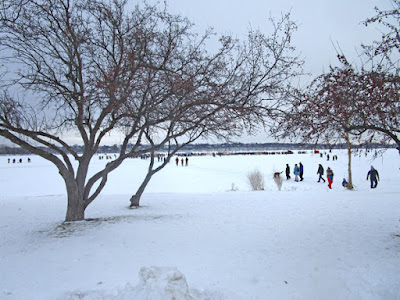
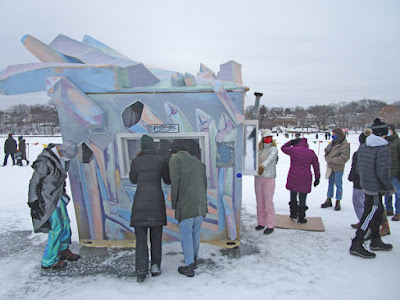
If you're suffering from the winter blahs, a trip to the Ice Shanty Village out on Lake Harriet might be just the thing. It's free (though donation buckets are widespread) and it's pretty safe, considering visitors are allowed into the shanties only one at a time. There's a food truck or two parked near the bandstand on shore. And once you're out on the lake you can wander through an assortment of "themed" structures most of which can be fully experienced from the outside.

I have to admit that I didn't read most of the printed signs describing what individual structures were supposed to be exhibiting. The whimsy was obvious and striking; I wasn't in the mood to think too hard about ecology or fake medical cures, and I didn't want to wait in line to go through one of the shacks. There were plenty of little kids already waiting. Nor did I try my hand at the magnetic poetry board, or snag a scarf or hat at the Ice Shanty "digger" store, where such things were hanging on clothes-lines, on offer for free.

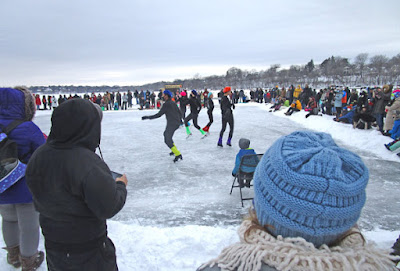
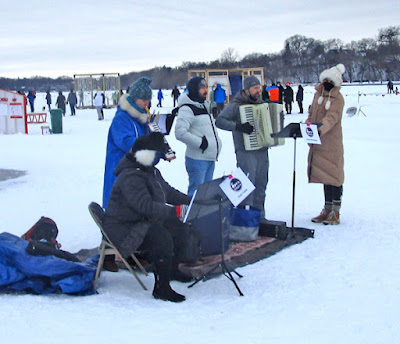
During the time we were there, hardly more than a hour, we saw a tremendous ice-dancing performance, and a group called An Opera Theatre gave wonderful renditions of arias by Handel and Puccini to the accompaniment of accordion, melodica, and guitar.

I especially liked the tenor aria, Ché gelida manina. The breezy, romantic tune has been coming and going in the back of my mind ever since, though I only discovered how appropriate it was this morning, when a friend identified it for me and translated the title: "How cold is this little hand." 

You can hear the windy sample I recorded here.

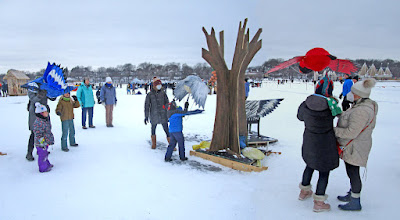
One of the displays consisted of a fake tree with a hanging bird-feeder. A few gigantic paper mache birds on poles were lying around with which you could attempt to extract potato-sized sunflower seeds from the hanging net bags. Sound like fun? 

Our most engaging conversation took place at a less than spectacular display largely consisting of knee-high gondolas stuffed with dried grasses. The young man in charge told us he was a graduate of MCAD who specialized in environmental sculptures made of mud and sticks. Somewhere along the way it occurred to him that creating gardens with live plants would be more fun, and might also be a way to make a living.

I was listening to him as he spoke, but I was also slowly identifying dead plants in his display, one after another: baby bluestem, milkweed, bee balm, common goldenrod.

You can see the prairie plant display in the middle distance

"Do you have any Joe Pie weed?" I asked.

"Not here today, though it's one of my favorites."

"We're birders, and we spend quite a bit of time out in the prairie. That's why we know a few of these plants."

"My girlfriend is a birder," he said. "We were up at a place called Sax-Zim Bog the other day. We saw a few things, but no owls. It's an enchanting landscape. Have you been there?"

"Many times," I said. "We were there two weeks ago. We saw redpolls, pine grosbeaks. But I've yet to see a boreal chickadee."

"We did see one of those, right out behind the visitors' center."

'Oww," I said, "That must have been a thrill. Just this morning we saw a bird neither of us had ever seen before. A black duck. It typically hangs around with mallards, and looks like a very dark female mallard. I've spent thirty years looking at female mallards, saying, "Well, that one looks a little darker. Maybe it's a black duck ....But this morning, it was like WOW. That's a very dark mallard."

Our black duck

"Same with the boreal chickadee," he said. "We kept seeing chickadees and hoping they had those little differences. The auburn streak on the flank. And then we saw the real thing and it was obvious."

"Another thing I've noticed," he added. "The arts community is very supportive and all that, but ... there's also a lot of ego involved. Birders are a much more relaxed and congenial crowd."

Mostly true.

The waste-time machine

The weed display wasn't drawing much of a crowd—the plants weren't colorful and there was nothing much for the kids to do—but we enjoyed both the arrangements and the conversation. 

We continued our wander past the waste-time machine where you sat at a desk and described exactly how you wasted time. It's one of my favorite themes, though I thought it best not to waste other people's time buy writing an essay on the subject myself. We also passed a giant-sized kaleidoscope that you could go into and spin the dial, and a vaguely metallurgical shanty whose import escaped me entirely.  .  

I have no idea what this was all about

  It was a great way to get out on a balmy Saturday afternoon. And walking back to the car through Linden Hills was also a minor treat. There are lots of attractive old houses in that staid and trendy neighborhood. 

"I think Brenda Ueland lived somewhere around here..."

Monday, January 17, 2022

North Woods Elementary


 I recently fetched a book being held for me at the Golden Valley branch called Icarus Fallen: the Search for Meaning in an Uncertain World by the French intellectual Chantal Delsol. (It can be interesting to explore what our brothers and sisters in Europe are thinking about every once in a while.) In her opening salvo, however, Delsol sketches the mood of the times with an unusually broad brush: 

Western man at the beginning of the twenty-first century is the descendant of Icarus. He wonders into what world he has fallen. It is as if someone has thrown him into a game without giving him the rules. When he asks around for instructions, he is invariably told that they have been lost. He is amazed that everyone is content to live in a world without meaning and without identity, where no one seems to know either why he lives or why he dies.

I have gotten to know quite a few people in the United States and Europe over time, and I have yet to find even one who matches that description. Perhaps it's an academic disease?

Yes, Delsol is a philosophy professor at a university in suburban Paris. She is perhaps embarrassed to acknowledge that if a significant proportion of the Parisian population feels the way she describes, a half-century and more after Jean-Paul Sartre and others popularized ennui, the reason might be a simple one: the decline of metaphysics.

Metaphysics is the study of elemental things: the one and the many, the parts and the whole, being and non-being, identity and difference. In short, the whole ball of wax. The elements involved are simple, but the reasoning patterns, for precisely that reason, can be bizarre, and firm conclusions elusive.

I have never lost my enthusiasm for pondering the BIG questions. One of the best places to ponder them, I've found, is with Hilary, on the North Shore, under a starry sky, in the midst of the elements, with a carefully selected stack of books sitting on the floor by the fireplace.

 At the top of my stack during our recent New Year's trip were Chet Raymo's An Intimate Look at the Night Sky, the late Robert Bly's My Sentence Was a Thousand Years of Joy, and a book called Metaphysics and the Idea of God by a little-known German theologian named Wolfhart Pannenberg. 

I brought Raymo up for the star charts, but found the text, which I hadn't looked at closely for years, fit my mood, too. At one point, for example, he brings up the classic question of Olbers' Paradox: If the universe is infinite, why is the night sky dark rather than bright? Raymo seems to think that the Big Bang Theory, about which Olber knew nothing in 1897, clarifies everything." If the night sky is dark," Raymo argues, "it's because the universe is young."

That makes no sense at all. Most astrophysicists agree that the stars are shooting away from one another at unimaginable speed. If so, then I would imagine that as everything gets farther and farther apart, the universe will grow darker still. In fact, the Big bang Theory would seem to suggest that the universe is NOT infinite but finite, which would shoot a big hole in Olbers' Paradox from the get-go.

These aren't, perhaps, the kind of things you think about when you're standing in the dark under the starry firmament in deep winter, but they are the stuff of metaphysics. Perhaps we could take things a step further and suggest that the concept "infinity" is a human construct created by mathematicians and other speculative thinkers. They draw our attention to the limits of particular things—the hem of a skirt or the edge of a coffee table, for example—and then say, "Now imagine something that has no edges but goes on forever."

When we imagine such things, what we tend to see is deep dark outer space. There might be an edge out there, but probably not; and if there is, we'll never see it, even with the new Webb telescope. And if we do catch a glimpse of that edge, there's no telling if something lies beyond that edge or not.

In short, infinity is a fiction. But it's an alluring one that answers to something deep within our selves, and the night sky brings that connection to the surface. That may be why Plato reasoned that the stars are individual souls twinkling in perpetuity.

We stopped at Sax-Zim Bog on our way up to Castle Danger, ate a late lunch at the Wilbert Cafe in Cotton, and came into Duluth via Highway 53. We drove through the UMD campus on Skyline Parkway, missing a few turns along the way,  and caught several glimpses of Lake Superior far below us, with the pink-orange light of the setting sun sweeping across it, highlighting the patchwork pattern of open water, smooth and shiny, interspersed with the dull, rough stretches of floating ice and slush.

The stars were spectacular that first night. The brightest I've seen in years. No moon, no clouds, and little ambient light beyond a single yard-light well down the road. Above us Orion, Taurus, the Pleiades, Sirius, Capella, blazing in the midst of an intense blue-black screen. With the help of binoculars we also spotted the Beehive Cluster and Andromeda without difficulty.

We went out again the next morning. Still pitch black. It's interesting to see Leo directly overhead, and Cassiopeia upside down, an elongated M on the horizon to the northwest. The frigid air clarifies everything and makes the stars appear more intense. 

During the ten minutes we were out, I saw two shooting stars. It's the Quadrantid Meteor Shower! 

But on our second day the wind came up, the clouds rolled in, and the waves got fierce. Out came the books. Opening the Bly collection I came upon this gem:

Loafing with Friends at Ojo Caliente

Mineral pools remember a lot about history.

Here we are at Olo Caliente, sitting together,

soaking up the rumble of earth's forgetfulness.


Why should we worry if Anna Karenina ends badly?

The world is reborn each time a mouse

Puts her foot down on the dusty barn floor.


Sometimes ohs and ahs bring us joy. When

you place your life between the vowels, the music

Opens the doors to a hundred closed nights.


People say that even in the highest heaven

If you manage to keep your ears open

You would hear angels weeping, night and day.


The culture of the Etruscans has disappeared.

So many things are over. A thousand hopes

F. Scott Fitzgerald had for himself are gone.


No one is as lucky as those who live on earth.

Even the Pope finds himself longing for darkness.

The sun catches on fire in the lonely heavens.


This isn't metaphysics, but the juxtaposition of images may reach important zones of feeling in the same way that the stars do. The kind of feeling that almost seems to drift into a cosmic understanding, or comfort. 

Too often we read a poem hurriedly. We get to the end and say, "I liked that, though I don't know what it means," or "That was a dud." And move on. What are we looking for? How is it possible to dwell with a poem, line by line, collecting the vectors and the valences, as if to generate, from such data, a new vision of the universe?

You can spend hours reading a self-help book loaded with case histories, anecdotes, and sage words of advice. Or you can read:

—the speed of the soul leaping over fences

Brings the toe forward. At other times, a book resting

On my chest takes me backward into my mother's arms ...

 By now, the baked potatoes must be done, and the broccoli is stewing in its own dissipating steam.

______________

The next morning the air is warmer, but little else has changed:gray skies, high winds, big waves. It's still dark outside, though I can see the branches of the spruce tree bobbing up and down outside the window. 

"A theological doctrine of God that lacks metaphysics as its discussion partner falls into either a kerygmatic subjectivism or a thoroughgoing demythologization—and frequently both at the same time."

Good heavens. We wouldn't want that to happen. And a few pages later:

"I am skeptical of the claim that with the notion of highest perfection we have already reached the idea of God. The idea of God, however construed, has a considerably higher specificity ... [It] cannot be separated from the elements of personality (however we are to understand it) and of a will (whatever form it takes)."

I agree, though it all sounds a little vague. We're in the company of Wolfhart Pannenberg now, known to his friends as Wolfie. He seems to be on the right track and is careful not to let the rhetoric become too seriously detached from experience. And yet, he concludes one chapter:

"After all, it is for the sake of the task—the task of achieving a comprehensive interpretation of the finite world—that metaphysics attempts to rise above the multiplicity of the finite toward to idea of the One, a one that grounds the unity of the world and provides a unifying context for the multitude of things within the world."  

Unity? The One? We ought to be suspicious of such concepts. Is that what anyone really desires? Not at all. Unity is dull, oppressive, stultifying, and so all-absorbing as to squelch personal identity and critical judgment alike. What we're looking for in the midst of life's multiplicity isn't unity, but harmony, which is made up of nourishing interactions between things. Including, I suppose, the various parts of ourselves.

                                                   ______________

This afternoon we drove up to Tettegouche State Park and hiked in to the bridge across the Baptism River through spruce woods and aspen woods--a hike punctuated by a few meadow-like openings with impressive views of distant peaks. 

Back at the cabin, the waves continued to roll in, maybe ten feet high, never really forming a pattern, gray and dark, lumbering in, noisy and mesmerizing to watch from the windows. Here comes a good one. And look, that one fractured in the middle, and the previous wave, which showed great spread and promise thirty feet out from shore, has ended up being a dud.

We evaluate the waves like surfers, though almost every crash leads to dissatisfaction. There is no finality to it! When the wind dies down it will take two days for the energy gathered out on the lake to spend itself here on shore. Water foams or slithers away across the rocks just as a new crest approaches. The process is endless, and I suppose the incessant noise might put some people on edge, unlike the various clicks and hums resounding at random intervals from the baseboard heating here inside.  

A pine grosbeak sits in the snow under the window; he's reappeared several times, working his way through the shriveled berries in a mountain ash. Splashes of orange-red under the wings and on the rump, and a little touch of elegant green on the head, but mostly a lumpy gray—the avian equivalent of a manatee rather than a dolphin.

We take a walk down the road toward the highway with the roar of the wind at our backs. Darkness is closing in. We've heard coyotes howl along this road, but not tonight.

On the menu: spicy Thai chicken meatballs braised in coconut milk.

We make the meat balls together, brown them nicely in a beat-up frying pan. Now Hilary is at work at the kitchen counter, chopping the cilantro. Back on the couch, I open a book by Ortega y Gasset at random and read:

"Thoughts arise in the mind spontaneously, without will or deliberation on our part, and without producing any effect whatever on our behavior." 

Tuesday, January 11, 2022

Kirk Cousins and Me


 We use the phrase "the holidays" for that stretch of celebratory events with friends and family that often runs from Saint Lucy's Day (December 13) past the winter solstice, Christmas, New Years, and even, for some, as far as the Orthodox Christmas on January 7, with concerts, dinners, religious observances, maybe a bonfire or two.

And then the morning arrives when you realize it's all over and a fresh new year is staring you in the face. That's a good time to get a haircut. 

I drove out to one of the chains in Minnetonka—Great Clips, I think. Now that Fantastic Sam's has raised their rates, I've been shopping around. This particular storefront is sandwiched between a Caribou Coffee and a Wild Bird Store, with Trader Joe's right around the corner, so it has potential.  

The monitor said it would be a 23-minute wait, but I'd brought along something to read: Romanticism—a Very Short Introduction from Oxford University Press. I chose this book not because I was in a romantic mood, but because it's the smallest paperback I own: 4-1/4 by 6-3/4, and only 3/8 of an inch thick. It would be nice if they had a similar volume called German Romanticism, because that particular group—Lessing, the Schlegel brothers, Schelling, Schleiermacher, the Humboldt brothers, Novalis—is a tough nut to crack.

The wait wasn't all that long. After the stylist had set me down and draped the black sheet over my chest she said, "So, what have you got going today?"

"I was afraid you'd ask me that," I said.

She grumbled something about the Vikings on course to lose to the Bears, and I replied, "I'm not much of a football fan. I watch the highlights sometimes. I wouldn't recognize Curt Cousins if I passed him in the street."

Pause. "I also cut hair down in Eagan," she said. Another pause. "I cut Curt Cousins' hair. His name is Kirk." Really?

She informed me that he's a very nice guy, likes Minnesota, sends his kids to public schools, always gives her a $50 tip.

I was happy to hear it. "But Tom Brady isn't a nice guy," she continued. "Mahomes, now he's very nice."

"Well, he seems pretty nice on the Subway commercials," I said. I presume she doesn't cut Brady's hair, but heard all this from Cousins.

"Kirk  isn't sure how long he wants to keep playing," she said. "One thing money can't buy is your health."

"It's true. You're probably too young to remember Robert Smith," I said.

"What? I remember Tommy Mason, Fran Tarkenton."

"OK. I believe Smith retired in his prime and got a law degree."

"Back when the Vikings played at the Met, you could meet the players after the game," she said. "It's not like that now."

"I saw Joe Kapp play at the Met," I said. "We lost 33-3 to the Rams. In the snow. It wasn't much fun."

I was going to mention that I knew Tony Oliva's daughter, but thought better of it. I don't know her that well. Then again, how well does she know Mahomes?

Meanwhile, she was doing a careful job on my tangled gray mop. But she wasn't wearing a mask, and it suddenly occurred to me that Kirk Cousins isn't vaccinated. In fact, he had Covid just two weeks ago. Hmmm. I wonder when he got his last haircut?

I was going to ask my stylist if she was vaccinated, but what would be the point? If she said No, would I leap up, grab my coat, and head for the door? Not likely.

The Vikings ended up winning the game. When I got home I tuned in and saw a few minutes of the fourth quarter, which included two wild, open-field Viking interceptions that reminded me of my touch football days. The win was meaningless, of course. The Vikings are out of the playoffs. All well and good. Why prolong the agony? And the Australian Open is starting any day now. Spring is right around the corner.

Later that afternoon I was rummaging through a desk drawer and made two important discoveries. One was a sheet of paper containing the lyrics to a French-Canadian shoe-passing game called Sorry Sue, written out long-hand, that we used to play at Christmas time.

Savez vous passer la traderailera

Savey vous, passer, ceci sans vous trompez

But we sing it like this:

Sorry Sue passey suree suri, surroo

Sorry Sue, passey, suree suri surroo

The other was an envelope containing three photos. One was a snapshot of the author Jon Hassler on the deck of a sailboat, one was a photo of Norton Stillman, circa 1980, at a baseball game out at Met Stadium, and one was a picture of the Bookmen ad hoc touch football squad from (just a guess) the mid-1980s.

There's me, Mike, Chuck, Roy, Jim, Rod, and John. Mike became a cop, Chuck now runs a cash register at a co-op in Grand Marais, Rod is a Unitarian minister in sunny California, and John works the floor at The Home Depot in St. Louis Park. Every time I run into him he says the same thing: "If I'm ever on 'So You Want to be a Millionaire' you'll be my lifeline." OK.

What happened to Roy and Jim? I have no idea.    

Thursday, December 30, 2021

Gee Whiz! : Three Books About Science

No sooner have I written this title than I see that it's inadequate. The word "science" is a kindergarten word. What follows is a description of books about three men who were deeply interested in the world around them. But that, too, is inaccurate.  What we have here is three books, two of which were written by insatiably curious men about other men in the past that have stimulated their interest because these men, too, were inordinately adept at examining and appreciating the wonders they observed all around them. These two books are accompanied by a third which describes the journey by an individual who was similarly inspired by his surroundings to describe the path he followed to pursue his dream of examining that world in greater depth.  

It might also be worth mentioning that all three books have a worldly or even cosmic scope, but also a regional focus. Seb Falk, who teaches at Cambridge, writes about discoveries in the library there and the lives of monks at nearby Bury St. Edmunds. (check) Hugh Aldersey Williams, a resident of Norwich, writes about the city's most famous son, Sir Thomas Browne, and  Gary Fildes writes about his own development as a budding amatuer  astronomer in the depressed Northumberland town of Sunderland. 

But enough about the inadequacy of titles.


In The Light Ages, Seb Falk introduces us to the world of medieval science by means of a single discovery. In December  1951 a young Cambridge researcher named Derek Price opened a manuscript lacking a title page but catalogued as an instruction manual for constructing an astrolabe, perhaps five hundred years old. He found something quite different. Instead of a manual written in Latin he found a work written in middle English and dated 1392 on every page describing an astronomical device far more complex than an astrolabe.. Geoffrey Chaucer had written a book on a similar subject just a year earlier, and there were grounds for suspecting that he had written this one, too.

As it turned out, Chaucer was not the author, but Falk makes a good story out of following the life of Brother John of Westwyk, the monk who did actually write it. He succeeds in clarifying the importance of such astronomical devices in an age that lacked firmly established calendars, but more than that, he recreates the world of monks, monasteries, universities, and daily life in medieval England without drawing undue attention to the religious elements involved. And considering how murky that age seems to most of us, Falk does a remarkable job a describing the era on its own terms, rather than as a half-baked preamble to more modern scientific discoveries and principles. Hence the book's title. Not the Dark Ages, but the Light Ages.  

"On Westwyk's journey through medieval science  [he writes]  we will meet a fascinating cast, none of them household names. The Spanish Jew- turned-Christian who taught a Lotharingian monk about eclipses in Worcestershire; the clock-building English abbot with leprosy; the French craftsman-turned-spy; the Persian polymath who founded the world's most advanced observatory. Medieval science was an inter­national endeavour, just as science is today. Religious belief spurred scientific investigation, but deeply devout people had no problem with adopting theories from other faiths. .. Watching how one individual knew what he knew will help us understand the ways medieval thinkers built on each other's work and influenced other scholars working in different languages thousands of miles away."


Falk has enormous enthusiasm for the astronomical principles that Westwyk and others put to use in constructing their time-keeping and navigational devices, and he tries his best to pass that on to us. The book is also amply illustrated with diagrams full of azimuths, zeniths, ascensions,  and astrological signs. But this material, while central to the narrative, is perhaps the book's least interesting element. After all, few of us will ever use an astrolabe, much less build one for our own use. But equally vivid are Falk's descriptions of daily life, social organization, crusades, plagues, medical lore, international development and exchange, and other more or less incidental stuff. We lose track of Westwyk and other characters for pages and sometimes chapters at a time, in part because longs stretches of his life have left no record, but also because Falk in intent on fleshing out the material required to help us understand the broader scene. The book carries all the fascination of Evan S. Connell at his best, but with boyish enthusiasm in place of Connells often mordant humor. 

Hugh Aldersey-Williams embarks on a similar mission in The Adventures of Sir Thomas Browne in the 21st Century. His focus is ostensibly narrower—the writings of a single seventeenth-century physician and essayist mentioned in the title. But Browne wrote about so many things that Aldersey-Williams  has his hands full examining even a representative sampling. In any case, his intent is not to convince us of how modern Browne was, but rather, to introduce us to his life and work, and also to suggest that quite a few of Browne's beliefs and speculations, which may seem odd or out-of-date or simply wrong at first glance, offer surprising parallels to the practices and uncertainties of our own time. 

Aldersey-Williams  begins his essay with a narrative of a dramatic witch trial during which Browne was called upon to testify as an expert witness. Browne offered his opinion as a physician that the fits and other symptoms exhibited by the two allegedly "bewitched" children were natural. But he went on to say, "gratuitously" in Aldersey-Williams' view, that this very naturalness was "evidence of the subtilty of the devil, who was controlling the witches actions." This comment likely contributed to the conviction and death of the two women accused of bewitching them.

Why did Browne add that remark? Aldersey-Williams  doesn't know, but he takes the episode as emblematic of Browne's often maddening equivocations and seeming indifference to the resolution of vital questions of the day. Like Montaigne in southwest France at an earlier date, Browne wrote during a period of intense religious and political strife, though you'd hardly know it by reading him.

Alongside his career as a physician, Browne took and interest in, and wrote about, many aspects of natural history, in the spirit, not of exact science, but of curiosity. Aldersey-Williams  organizes these ruminations into categories such as Plants, Tolerance, Melancholy, Faith, and Science, one chapter per subject. Within each category there is room for a wide variety of observations and musings, both on Browne's part and on that of his later-day biographer. The two are equal partners, in fact, and Aldersey-Williams' reflections are a vital part of the "dialogue."

For example, Aldersey-Williams  opens the chapter titled "Physic" with the case of a 102-year-old bulimic woman that Browne is treating. Browne, after describing the woman's condition and indulging in a digression that takes him through one of Plutarch's anecdotes, concludes: "though I am ready to afford my charity unto her, yet I should be loth to spend a piece of ambergris I have upon her, and to allow six grains to every dose till I found some effect in moderating her appetite; though that be esteemed a great specific in her condition."

Aldersey-Williams  acknowledges that it's easy to dismiss the medical practices of Browne's day as "insufferably primitive," yet he also notes striking parallels to modern attitudes and techniques.

"It is in its way a thoroughly modern encounter. Browne displays curiosity and compassion. He is alert to a possible connection between the woman's medical condition and her environmental circumstances. The medicine is unusual but like all medicines at this time it is natu­rally sourced rather than made artificially (ambergris is a fatty accretion ejected from the stomachs of sperm whales and could be found floating on the sea or lying on the coast). Browne has a clear idea of its specific effectiveness, and is aware that dosage is an important factor. He is also conscious that medicine costs money, that he must husband his resources in order to run his medical practice at a profit, and that attention given to a 102-year-old may not, in the end, be, as today's euphemism has it,' optimal resource allocation'."

The author  goes on the observe what everyone who's been to the doctor knows: today's medical practice also leaves a lot to be desired.  He describes a recent visit to a GP due to a stomach bug. "I am out in under ten minutes clutching a prescription for some opioid that will address my symptoms and a mild bewilderment at the doctor's lack of curiosity about the cause of my illness." The doctor also mentions antibiotics, but leaves it to Aldersey-Williams  to observe that no infecting bacterium has been identified, and the drugs would be unlikely to be effective. The doctor then asks Aldersey-Williams  if he wants a referral, without specifying what it would be for. "At the end I feel as if I have been played," he concludes, "and that he has had me labeled all along as one of the 'worried well'."

One of Browne's greatest claims to fame is as the inventor of new words. More than seven hundred neologisms have been attributed to him. Though many have since fallen from common use, a short list of his more durable creations (copied from Wikipedia) would include ambidextrous, antediluvian, analogous, approximate, ascetic, anomalous, carnivorous, coexistence, coma, compensate, computer, cryptography, cylindrical, disruption, electricity, exhaustion, ferocious, follicle, generator, gymnastic, hallucination, herbaceous, holocaust, insecurity, indigenous, jocularity, literary, locomotion, medical, migrant, mucous, prairie, prostate, polarity, precocious, pubescent, therapeutic, suicide, ulterior, ultimate and veterinarian. Aldersey-Williams  devotes some time on this aspect of Browne's genius, but finds the task daunting, and soon decides to highlight one or two here and there as they appear in the text with extended notes at the bottom of the page. Good idea.

In the chapter on Animals, Aldersey-Williams  draws from the text of Browne's work Psuedodoxia Epidemica to create an impromptu bestiary that includes the ostrich, the bittern, the owl, the sperm whale, the mole, and the badger, among other creatures. Because the book from which the material is drawn is devoted to what Browne calls "vulgar errors," these two-page entries are more odd than accurate or informative. For example, in Browne's day many people thought the legs of a badger were shorter on one side than the other, because these creatures were often seen running rapidly down the furrows of a plowed field.  Browne rejects this thesis, not by examining a badger or a badger skeleton, but on the strength of inductive reasoning: the legs of all other animals are the same on both sides. If a badger were differently construed, it would, in Browne's words, be "repugnant unto the course of nature."

Aldersey-Williams  is disappointed by Browne's conventional line of reasoning in this case. A more Brownian solution would have been to capture a badger, chain him to a tree, and measure his speed going clockwise and then counterclockwise around it. If the times differed, it would "prove" that the animals  legs were not the same length on either side.

Such flashes of whimsy appear through the books. Yet it's clear that Aldersey-Williams  knows the man he calls his "hero" inside and out, and has read and absorbed even the driest and least interesting of Browne's works, thus saving us the trouble. I've poked my nose into Browne's Religio Medici, his Urne Burial, and one or two other works with interest—the era, the style, the mood, the quizzical intelligence come through—but when push comes to shove, Aldersey-Williams' book is more stimulating, thought-provoking, and fun to read by far.


An Astronomer's Tale: a Life Under the Stars
, is a simpler book. Its author, Gary Fildes, grew up in a working-class home and began his professional career as a brick-layer. He went to soccer matches with his "mates" and brawled with fans of the opposing team almost by instinct. But he harbored a secret love for the night sky that was nurtured by family and a neighbor with similar interests, and a good telescope. This is the story of how Fildes, with tireless enthusiasm but no formal training in astronomy, guilelessly pursued his interests and eventually became director of the Kiedler Observatory in Northumberland, a public institution that's located in one of the world's most spectacular dark-sky havens.

Fildes isn't a researcher or even an expert astronomer; he's an educator. His passion for watching the night sky is evident on every page, and every chapter is punctuated with a section describing the night sky at a given time of year and focusing on a specific constellation. The book chronicles Fildes' extraordinary rise in the field of science education, which surprised him as much as anybody else,  in terms designed to encourage others to do the same. Or at the very least, to do a bit of reading, then find a dark place, and stand in awe of the heavens in the midst of which we go about our daily lives.