Wednesday, July 9, 2014

World Cup Notes


Part of the appeal of the World Cup is that the entire world, more or less, gets involved in a single game, a single competition. None of those Olympic medal counts: Are two bronzes worth more than one silver?

Also, the game is deliciously simple, especially to those of us who don’t know a center back from a forward, have difficulty distinguishing a challenge from a tackle, and have no idea when either maneuver might be considered a foul.

A third merit of the event is that we Americans have no vested interest in it. Sure, it’s exciting to see our team advance. But we know they aren’t going to win the thing.

Meanwhile, the aesthetics of the game soak in intuitively, and we begin to appreciate the flow, the passing, the  disruptions, the counter-attacks. And of course, the scoring.

Germany’s semi-final game with Brazil was a scoring seminar. As it happened, all the scoring was done by the Germans.

Journalists immediately spilled a lot of ink (but not in a mean way) contrasting Brazil’s devotion to the game, and its host status, with the Brazilian team’s semi-final showing, which descended beneath “lackluster” to arrive at “dispirited” and “amateurish.” The team lost, the nation cried.

Before long, fans will be decrying the fact that in recent years, Brazil has abandoned its characteristically loose and flowing approach, o jogo bonito, for a more European approach that has obviously not produced the desired result. Pundits have argued throughout the early stages of the tourney that Brazil’s team wasn’t that  good, but it would make its way to the championship by an elusive magic that never fails them on their sacred  turf. (Brazil hadn’t lost at home in a Cup competition since 1975.)

What I enjoyed about the game was the sophistication of the German scoring. Although the announcers made use of such terms a “ruthless” and “machine-like,” what I noticed about the German attack was how often the players made that final, extra, pass to a teammate in front of the box, eschewing personal glory for the sake of a better scoring chance.  On one cross, midway through the first half, one of the Germans feigned a shot but allowed the ball to whiz past to a teammate who drilled it home. (Or perhaps he just whiffed?)

When Chris Wondolowski blew his chance to score for the United States, late in the match against Belgium—a score that would probably have won the game and allowed the team to advance—Clint Dempsey was standing a few yards away, unmarked, facing a wide-open net. (To be fair, Belgium missed about twelve scoring chances in that game, too. And if Wondolowski  had bobbled the pass, the cries of “Why didn’t you shoot?” would have been unceasing.)

The German passing seminar was made possible by the porous and tentative  nature of the Brazilian defense, no doubt. But the Germans seemed to know exactly how to penetrate it, without rushing overmuch to get a shot off.


Yet the fact remains that in many circles German’s team commands admiration...but not affection. Fans get excited about Mediterranean types of small stature weaving their way through crowds of defenders (Messi, Iniesta) or midfield masterminds cooly directing the show (Pirlo, Zidane). The trouble with the Germans is that they all seem like the same person. When Miroslav Klose scored his 16th career World Cup goal, eclipsing the record previously held by Ronaldo, the celebrations were muted in Brazil, naturally enough. But is there anywhere outside Germany where soccer fans have embraced Klose in the same way they embraced Ronaldo, populary dubbed Il Phenomeno?

I really don’t know.

Then again, as you can probably tell, I don’t know much about soccer.

Yet I have been enjoying the German contribution to the current World Cup, starting with the American coach, Jurgen Klinsmann. Reading about Klinsmann’s relocation to California, I was reminded of an unread novel that was smoldering in the basement collection, Martin Walser’s Breakers. Walser’s novels (Runaway Horse, The Swan Villa, Letter to Lord Listz, etc.) are all the same, in so far as the narrator is a put-upon German male yearning for respectability but doubtful about what others may be thinking about him. 

Breakers is no exception, though it’s given an extra twist by the fact that the narrator is trying to ingratiate himself into a scholarly California crowd, after receiving a four-month appointment to teach German conversation at a small Oakland college.

Just this morning, it occurred to me that what I really ought to be reading is Peter Handke’s Goalie Anxiety at Penalty Kick. I see they have two copies at the downtown Minneapolis library, and neither is checked out!

I may head down to pick up a copy this morning. But let me assure you that as I read it, I'll be listening to Brazilian diva Marisa Monte on the stereo.


Wednesday, July 2, 2014

The Conceptual Sympathy of Ernst Cassirer


 Novelist are sometimes lauded for their ability to make a wide range of characters—even the most despicable—understandable and even compelling, if not likable. Call it intuitive sympathy.

We less often meet up with the notion of “conceptual sympathy”—the ability to set the ideas of a given thinker in the clearest light, exposing the nugget of insight that remains valid without dwelling overmuch on the dross and confusion surrounding it. The German philosopher Ernst Cassirer possessed this ability to an unusual degree.

Let me give you an example from his late work, An Essay on Man (1944). Summing up the position of the Stoics, he writes:

He who lives in harmony with his own self, his demon, lives in harmony with the universe; for both the universal order and the personal order are nothing but different expressions and manifestations of a common underlying principle. Man proved his inherent power of criticism, of judgment and discernment, by conceiving that in this correlation the Self, not the universe, has the leading part…” 

And a few sentences further on he concludes:

This spirit [of Greek philosophy] was a spirit of judgment, of critical discernment between Being and Non-Being, between truth and illusion, between good and evil. Life in itself is changing and fluctuating, but the true value of life is to be sought in an eternal order that admits of no change. It is not in the world of our sense, it is only in the power of our judgment that we can grasp this order. Judgment is the central power of man, the common source of truth and morality. For it is the only thing in which man depends entirely on himself; it is free, autonomous, self-sufficing. 

 Cassirer is summarizing the position of Marcus Aurelius here. It’s not clear whether he endorses it entirely, but he describes it eloquently. The association of judgment (rather than verification) with truth and being is sound.

 But there are some problems here, too. In particular, the divorce of judgment and sense seems unnecessary and even perverse. To what, after all, do we apply our judgment except our experience, which is derived largely from our senses?

By the same token, is it really true that judgment is “the only thing in which man depends entirely on himself”? Judgment might be considered autonomous is so far as it leaves behind all arbitrary norms and standards. But we apply our judgment to things we come upon, things that lie beyond us. When we’re moved by a work of art, for example, and judge it to be beautiful, the judgment may be ours alone, but the work of art remains a foreign object. That we can respond to such experience at all might be offered as an argument in favor of the Stoic position Cassirer has already described, whereby “the universal order and the personal order are nothing but different … manifestations of a common underlying principle.” But if this is true, then, far from being autonomous, judgment is based on that principle, and reaffirms our connections to things both within and beyond our selves—the murmuring harmonies and discords of life.

According to Cassirer, this is the sort of judgment Jesus executes, and within a paragraph or two of this sympathetic description of Stoicism, Cassirer introduces Christianity as the major historical challenge to the Stoic position. Did Christianity refute Stoicism? Not really, Cassirer tells us. He notes that the two systems have a great deal in common. He breezes past Jesus, however, whose maxims are perhaps too enigmatic and contradictory, in his eagerness to introduce us to the more conceptually fleshed out notions of St. Augustine.

And so it goes. In succeeding pages, Cassirer presents us with similarly cogent references to Montaigne, Descartes, and Pascal, whom he clearly admires. As we meet and greet Bruno and Diderot, we may begin to feel that in the course of a few pages, under Cassirer’s gentle guidance, we’re finally getting a grip on the Western intellectual tradition.

Cassirer is impressed with Darwinian evolution, though he observes astutely that its impact on philosophical speculation was rooted less in the “facts” of evolution that in the theoretical interpretation of those facts—an interpretation that had a definite metaphysical character. He points out that Aristotle had an evolutionary theory, too. But in Aristotle’s view, evolution was driven by “final causes.” That is to say, less advanced species were developing toward the supreme species—man. For Darwin, on the other hand, evolution was being driven by accidental causes. It has no pre-determined end or final form.

“Modern thinkers,” Cassirer writes, “have…definitely succeeded in accounting for organic life as a mere product of chance.” 

But have they, really? In defense of this claim, Cassirer quotes a passage in which Darwin describes an impressive edifice being built using no material other than the random pieces of rubble he finds at the base of a cliff. Darwin concludes:

Now, the fragments of stone, though indispensible to the architect, bear to the edifice being built by him the same relation which the fluctuating variations of organic beings bear to the varied and admirable structures ultimately acquired by their modified descendants. 

The careful reader, pursuing the analogy to its logical conclusion,  might respond: “Then who is this architect you are referring to? Who is this architect of individual creatures, of Life?”

An architect who builds an edifice begins with a design, a sense of scale and proportion, an aesthetic, and a utilitarian purpose. He chooses his stones accordingly. If his choice of building material is limited to what lies near at hand (and is therefore “accidental”) that will influence the design of the finished product, but only to a degree. Such limitations having been granted, the completed edifice will reflect the architect’s intention.

This scenario doesn’t resemble the evolutionary path in the slightest. When an organism receives a freak mutation, there is no architect present, and neither intention nor choice are involved. Very few mutations are environmentally beneficial. Most peter out within a generation.

Evolutionary development only becomes explicable when we include, along with all the accidental causes, the intentionality of the individual creature, who seizes and makes use of an accidental advantage, imbuing it with value, as it were, and passing it on to its descendants. Both the accident and the urge to thrive are necessary for development. Accident alone produces nothing but chaos.

Cassirer notes that during the course of the nineteenth century, philosophers enamored of Darwinianism found it imperative to explain the diversity of human cultures by recourse to simple mechanisms: “Nietzsche proclaims the will to power, Freud signalizes the sexual instinct, Marx enthrones the economic instinct.” 

By this point in time, in Cassirer’s view, “our modern theory of man lost its intellectual center.” (P. 21) Man has made his way from metaphysics to theology to mathematics to biology. Now a “complete anarchy of thought” holds sway, a dreadful “antagonism of thought” in which every thinker relies on “his own conception and evaluation of human life.”

Things sound pretty bad, and more than a few scholars have written weighty books about the “crisis” of late nineteenth-century thought. And yet, doesn’t it also sound strangely familiar? Ten pages earlier, Cassirer had been praising a Stoic world view based on personal judgment, “The only thing in which man depends entirely on himself.” Now he’s describing a very similar situation, in which every thinker relies on “his own conception and evaluation of human life.” But now he's describing it as a world of “complete anarchy.” What happened?

My point is not to challenge Cassirer’s judgment, though I think he’s missed the mark, here, perhaps under the influence of the chaotic and colossally destructive historical situation under which he was writing. What I’m impressed with is Cassirer’s knack for calmly highlighting the essential virtue and drama of any given period, the critical thrust of any thinker’s work. 
 
In an earlier work, The Platonic Renaissance in England (1932), Cassirer makes an attempt to expose the historical significance of now-obscure English writers such as Whichcote, Henry More, and Cudworth. He paints a warts-and-all portrait of thinkers who wrote badly and at great length, but who nevertheless sustained important streams of thought  that were in danger of being submerged in the shallower but broader flow of British empiricism.

Especially interesting, at least to my mind, is the thirty-page digression he makes to explain how much more difficult to the Augustinian world view was the challenge presented by Plato, than that which Aristotle had offered at an earlier date.

He suggests that Aristotleanism, as it appears in the philosophy of Thomas Aquinas, does little to bridge the gap between knowledge and faith, reason and revelation, nature and grace. It was Aquinas's towering intellect that held things together.During the Renaissance the school of Padua, through “laborious philological and systematic analysis,” succeeded in showing how incompatible Aristotelian and Christian positions are.

During the Reformation the entire superstructure of scholasticism was set aside in an effort to return to the Christianity of Augustine and Paul. Cassirer writes: “It seemed finally as if Augustinian doctrine had triumphed over its great philosophical rival—indeed, as if it had emerged more formidable still from its controversy with scholastic Aristotelianism.”

But once Renaissance thinkers gained greater access to Plato’s work through translations, Augustinianism was essentially doomed. Plato’s theory of Eros as a bridge between the real and the ideal, and his association of Eros with “the Good,” (bolstered at a later date by Plotinus’s notion of the beautiful) had no use for Augustine’s higher power.

The Idea of the good is thus set forth not only as the end and aim of knowledge … but also as the strongest bond comprehending all being, earth and heaven, the sensible and the intelligible world. To question the Idea of the good, or to limit it by an ostensibly higher norm, would mean for Plato the dissolution of being itself and the sacrifice of all human as well as all divine order for chaos. Plato’s theology is thus based on self-reliance and on the self-sufficiency of the moral life. In so far as this self-sufficiency has its foundation in the will, there can be no absolute depravity of the will for Plato. The power of Eros constantly works against the doctrine of original evil and triumphs over it.

Bravo! After a lengthy discussion of Ficino and the Florentine Academy, Cassirer moves on to the influence asserted by Neoplatonic doctrines on the poetry of the English Renaissance. He has taken the time to set the stage for the appearance of the Cambridge Platonists, and in so doing, he offers us a brief and illuminating mini-history of Western thought.

It’s almost enough to make you hunt up that old paperback copy of The Fairie Queene!


Sunday, June 29, 2014

Twin Cities Jazz Festival 2014


Come for the music: stay for the atmosphere.

This might serve as a fitting slogan for the Twin Cities jazz festival, held every June in and around Mears Park in Lowertown Saint Paul.

The shows are free. The streets are blocked off. There are four outdoor stages and quite a few events scheduled in nearby bars and restaurants. Come early. Patronize the food trucks. It’s a good way to get to know the neighborhood.


As for the music, it’s a mixed bag of local, international, and marquee jazz performers. Too many guitars, too few keyboards and brass instruments. But that’s the way jazz has gone, and we can’t do much about it.

We arrived at 5 p.m. with collapsible camp chairs and considered ourselves lucky to stake out two spots on the east side of the plaza in front of the main stage. We caught the last two numbers of Red Planet, one of guitarist Deal McGraw’s groups. The first was a slow and slightly tedious blues number, but the group finished up with a rousing version on John Coltrane’s "India." Without much of a melody to work with, McGraw slashed through some very thoughtful and occasionally exhilarating changes.


By that point the plaza was filling but the woods and grassy knolls on the south side of the park still looked pleasantly pastoral, with picnickers here and there and children cooling their feet in the artificial stream that crosses it. 


Leaving our chairs behind, we paused briefly at the small Sixth Street Stage, where Peruvian guitarist Andres Prado was fronting a band with an unlikely name: Mississippi. Then we scoped out the food trucks on the east side of the park, returning to our seats with a hot dog and some chicken curry from a self-styled Afro-Italiano truck called the Cave Café.


Now a momentous strategic issue arises: move onto the grass on the other side of the plaza path, out of the direct sunlight? Yes. The sightline isn’t quite so good and the sound might suffer a little, but it’s a far more pleasant place to sit!

A new band appears. Dave Hegedorn (vibes) and Jon Weber (piano) backed by an astute rhythm section (Steve Pikal and Phil Hey) weave their way through some tasty standards. One of the best sets of the weekend.

Friends arrive and fill in the space next to us. We wander down to the Union Depot, where the Twin Cities Latin Jazz Orchestra is playing. The wind is gusting, dusk approaches, crowds are getting thicker, and there are times when the music sounds better from a distance, wafting between buildings and trees.  


By the time the Bradford Marsalis quartet took the stage, crowds were thick in the aisles and the MC had to tell the people standing four deep in front of the stage to move to the back so others could see. Marsalis immediately established a “command” on stage, and on the first number his pianist, Joey Calderazzo, played a solo so long and frantic I began to worry for the continued health of his forearms.

Marsalis himself shifted from soprano to tenor saxophone as the group canvassed a Bebop tune (was it Gillespie’s 52st Street Theme?), an original composition ( modal and intense), then a standard. Marsalis returned to the soprano for a ballad; it was dark, the conversational buzz in the park had jumped a few notches, the trees above our heads were rustling big time, and the young people sitting behind us (who appeared to have little knowledge of or interest in jazz, to judge from snippets of conversation that came our way) had gotten into party mode around the beer cooler.


Meanwhile, a couple sitting directly in front of us (inspired by the familiar rhythms of the standard, no doubt), had leapt from their chairs and begun to dance in the now-confined space they occupied. The man wore a pork pie hat, hadn’t shaved recently, and seemed to have picked up his dance steps from watching Jerry Lewis movies. His partner did her best to remain upright.

It was about time to go.

  
We beat the throngs out to the sidewalk and stood in the streetlight glare enjoying the encore—a soulful rendition of “St. James Infirmary.” Once again, the music seemed to come together into a coherent sound more forcefully from a distance.

Bradford’s set had been rousing, but also frustrating: so much good music had been lost to the environmental static.

* * *

Almost coincidentally, we dropped by the festival again on Saturday afternoon, on our way home from a bike ride in Washington County. The scene was pleasantly relaxed on the grass in front of Union Depot, where we heard two vocalists (Lucia Newell and Maud Hixson) shape tunes, backed by an attentive rhythm section that included pianist Rick Carlson and (once again) guitarist Dean McGraw.


On our way back to the parking lot, we passed the Jazz Education stage on Prince Street, in front of the Black Dog Café. A hip quintet of youngsters was just wrapping up a set, after which some educators summoned a group of twenty-odd teens in brown T-shirts who had been lying around on the sidewalk  (the Jazz Around Minneapolis Big Band) to gather with their instruments on the east side of the stage. 

They were on next!

Tuesday, June 24, 2014

Chef: The Film


 It’s one of those “small” films with stock characters, predictable plot points, and middle-aged stars in cameo roles, but it’s also a lot of fun. Jon Favreau (known to me as the director of Iron Man and Iron Man 2) wrote the script and takes the leading role, of a good-natured but hot-headed L.A. chef struggling with the tedium of producing the same restaurant menu night after night. 

When word gets around that the city’s leading food critic (Oliver Platt) will be stopping by for dinner—a critic who was instrumental in launching the chef’s career a decade earlier—Favreau buys the ingredients for an innovative menu, but the restaurant owner (Dustin Hoffman) puts the kibosh on his plans. “We’ve cooked the same menu for ten years and our patrons love it, and we will continue to cook it,” Hoffman asserts, in that tight-cheeked, nasal tone at which he is adept, while slamming a clipboard against the industrial kitchen counter.


Meanwhile, Favreau, who’s divorced, is also struggling to be a good dad to his quiet son, Percy,  in the midst of the demands and distractions of the restaurant business. The fable-like quality of the tale is made evident by the fact that Favreau’s ex is played by Columbian supermodel Sophia Vergara, and his head waitress by Scarlett Johansson. It’s bolstered further by the fact that Vergara lives in a palatial estate, courtesy of the divorce settlement with her first husband (Robert Downey, Jr.).

The plot’s catalyst is Twitter. Favreau doesn’t know what it is. Percy shows him how it works, and Favreau immediately (though inadvertently) gets into a flame war with the food critic (who, I hardly need to mention, was not impressed with his recent meal).

In the early stretches of the film, Vergara urges her ex-husband (with whom she’s on extremely cordial terms) to quit his job and return to his roots as a food truck impresario. So I won’t be giving away much  if I reveal that the second half of the film takes a turn in this direction.


There are plenty of luscious cooking scenes at the L.A. restaurant early on, and also at Favreau's bachelor apartment. There are more later, as Favreau and his old sidekick Martin ( John Leguizamo) put some spit and polish on a dilapidated food truck and drive it from Miami back to L.A., winning new fans all along the way with the help of their Twitter-savvy publicist, son Percy.

Chef is all in good fun, buoyed by a cheery energy and a palpable love of food. But if you do happen to see it, be forewarned: you’ll leave the theater wishing there was someplace nearby to pick up a good Cubano. (Manny’s Tortas at Mid-Town Market?)

*  *  *

Yes, Chef is a summer romp of a film, but it also raises an interesting question about restaurants: Is Hoffman right to demand a crowd-pleasing menu at the expense of Favreau’s “creativity” as a chef and his desire to shine in the industry? I would say yes. There is something deceptive, if not unethical, about preparing a special meal for a critic, who will then write about it favorably to countless readers, unless the restaurant plans to offer that same menu regularly. On the other hand, if a restaurant changes its menu seasonally, the chef and his (or her) staff would be less likely to get bored, and the owner would be comfortable with occasional changes to the menu. 

But then there wouldn’t be much of a film.

Tuesday, June 17, 2014

A Little Northern Spark


We lost power at about 7:30 p.m. It was as if the gods were telling us—yes, you must go down to Northern Spark! But if that was the message, then why all the rain?

With a few candles placed here and there and with headlamps strapped to our foreheads, we sat in the living room reading as the trees watusied outside the window. At 8 p.m. it started to rain hard. But at 8:30 it eased off again. The sky grew lighter. At 8:45 we said, “What the heck!”

Fifteen minutes later we were parked under the freeway just west of the Basilica of St. Mary. We walked across the small park in front of the church, made a dash across Hennepin Avenue, and entered the On Being store front where Krista Tippett runs her radio show. (I don’t really know what goes on there, but she has something to do with it.)

The gods were with us once again. No sooner had we entered the room that we spied our friend Margaret gesturing at us from the front row of seats. We hesitated—she didn’t know we were coming and obviously wasn’t saving those seats for us—but then we sat down next to her. A few feet in front of us a barefoot dancer in a green and gold dress was painting a simple but elegant floral design on the floor with white powder.

I was amazed by her ability to create a perfect arc, again and again, and I said to myself: I think she’s done this before.

Then a second woman stepped up to the microphone and read a few lines from a poem by Rabindranath Tagore about the earth. I had a hard time following it. It wasn’t complicated or obscure, but there were people talking in the hall behind us, others were coming in the door a few feet to her left, the rain was still coming down outside, and cars were passing by.

The wall to our right was filled with books to a height of eighteen feet.

Then the music started. And the dancing. Three women moved back and forth ten feet in front of us, making distinctive hand poses, squatting, extending their arms and legs as bells jingled on their anklet’s. Two of the women reminded me, not of India, but of Crete. The third had a pleasantly cherubic face. The foot-stomping occasionally brought flamenco to mind, but for the most part, the dancing was much more formal and precise, like an Egyptian hieroglyphic in motion. As if they were telling us a story in a language we couldn’t understand.

There were no slow passages, nor were there frenzied interludes. A premium was being placed on grace and body control. Yet a sense of the loveliness of the female form, and what it could do, shone forth with every gesture, every head-bob and foot-stomp and glance. This, perhaps, was what the poetry had been about.

In the course of their dance the women obliterated the ornate designs (called kolums) they’d drawn on the floor. When the piece came to an end, the creative directors of Ragamala, Ranee Ramaswamy and her daughter Aparna, explained the function of these kolums in village life as a means of greeting the day, honoring the goddesses of prosperity, and inviting them into the house. They also briefly explained what a few of the gestures mean and how they relate to village life in India today, and also as depicted in the art of the Warli, a tribe from southwestern India who have been painting murals along the same lines for upward of two thousand years. One such mural, painted by a Warli artist invited to the United States by the Ramaswamys for precisely that purpose, was hanging on the wall to the left of the stage.

 I know next to nothing about Indian culture, as you can probably tell, but the dancing reminded me of the frescos at Knossos and the footwork of Carmen Amaya and Christina Hoyos. The rain outside the window reminded me of the scene in the film Lagaan when the monsoon comes and everyone rejoices. And to my mind, the half-hour length of the program was perfect.  

After chatting for a while with Margaret, her husband, Dave, and their two late-arriving friends, who had just returned from a four-month educational cruise around the world,  we drifted out into the night, heading south toward Loring Park.

Rain or shine, this is the prettiest block in Minneapolis. It’s triangular, it has the Basilica to its north, a wonderful urban park to its south, a nice alley running down the middle of it—and the buildings themselves look like they belong in Paris.

A rock band was setting up in the first bar we passed. Next door, in Spyder Trap, a web design firm, two kids in their twenties were being filmed as they zoomed around on scooters.

Bar Lurcat was elegant and largely empty, like a scene from Midnight in Paris. People were out on the street or hanging from doorways, not because of Northern Spark, but because that’s what goes on down on Harmon Place every night.


We were headed for Luna Lux, a letterpress printing outfit. They were giving demonstrations and handing out miniature posters.

“Have you ever been to the Hamilton Wooden Type Museum in Two Rivers, Wisconsin?” I asked the woman who was pulling a little poster for us.

“I love that place,” she replied. “In fact, the director, Jim Moran, will be here in an hour. We all love Jim. His family has been in the business for centuries.”

From there we were faced with the choice of heading south across the park to the Walker Art Center, where literary folk recruited by Rain Taxi were offering to write you a personalize poem based on a Tarot layout, or proceed east, deeper into the city. Choosing the later alternative, we hoofed the quite streets for seven blocks to the plaza in front of Orchestra Hall, where a crowd had gathered.


The food trucks looked enticing but we prudently went inside and found two seats in the performance hall. The orchestra was already deep into Kevin Puts’s Symphony #4, and the sound was immense. I had forgotten how much fuller, richer, and, well, more impressive the Minnesota Orchestra is than its cousin across the river.


It took me a while to register the fact that a light-show was being projected onto the cubes behind the orchestra. I found these shifting images mesmerizing, then realized that they were distracting me, not from the music, but from the pleasantly random reveries that classical concerts always inspire. So I closed my eyes.


Out in the lobby after the performance (once again a perfect length at 25 minutes), we watched people form lines, touch electronic panels on the pillars, and generate digital sounds that filled the room and occasionally erupted into rock-n-roll for no apparent reason. The lobby itself, recently expanded, didn’t seem much bigger to me than the old lobby, but it’s definitely more antiseptic—not much of an improvement, perhaps, though difficult to judge in the weird blue light.

Quite a few people were dancing to a rock band playing in the new, glass-walled, annex west of the lobby. Meanwhile, the drizzle was intensifying. We bought a Thai pasty at Potter’s Pasties food truck--0h, that was good, what with the ginger and the sweet potatoes--and headed east for a few blocks toward the convention center plaza where Zeitgeist was due to perform at 11. (Incidentally, the festival goes on all night long.)

Then we turned around. We were getting wet. 

By the time we got to Hennepin Avenue the drizzle had turned into a deluge; we were soaked by the time we got back to the car.


Hilary (the goddess of endless energy) was eager to move on to the events down on the riverfront, or at least pay Northrup Auditorium a visit to hear the gamelan orchestra or perhaps a half-hour of Eric Satie's short and extremely repetitive piano piece, "Vexations," which was scheduled to be played ad nauseam throughout the night (just as the composer intended). I dutifully drove down Hennepin Avenue, where neon lights glowed in the rain and large crowds of people (most of whom, I’m sure, had never heard of Northern Spark) hugged the sidewalks, clustered under the theater marquees, and dashed in and out of bars and restaurants. 

It took a long time to get to the river, which looked pretty quiet. Suddenly the idea continuing on to the university campus,  parking at a ramp, and racing through the rain to Northrup, just didn’t seem that appealing to me. It was time to go home.

At least we’d gotten a taste of Northern Spark. And when you consider our day had also included a visit to the farmers market, a stop at the Midsummers Festival at the Swedish Institute, a few hours at the Japanese festival at Normandale Community College (where a book I worked on was being launched), and a few hours in front of the computer watching Italy defeat England in World Cup play, I think it's fair to say it had been a pretty full day. 

Tuesday, June 3, 2014

Washington Island (Door County - pt 2)


By the time we left the park it was after noon, and nearby Fish Harbor was simmering with Memorial Weekend vacationers. We crossed the peninsula to the “quiet side,” negotiating a major roadblock and following several back-country detours to avoid Jacksonport’s Maifest. The festival might have been fun, but we were on our way to The Ridges Sanctuary in Bailey’s Harbor. Here the dunes of Lake Michigan rise in a regular procession, and each brow further inland, as heavily wooded as the last, nourishes a different set of orchids and other plants.

We’d been there before, though I had no recollection of where it was located. I took a right turn on Ridges Road (makes sense?) and we followed it out along the shore to Tofts Point, where the road dead-ends.
Wrong road.


We hiked out to Toft’s Point itself, where quite a few Caspian terns were bracing themselves against a stiff wind coming in from the southeast across the vast open lake. The shoreline consisted of very flat slabs of limestone (I presume) covered here and there with a slurry of sandy muck that supported a smattering of grasses and stunted evergreens. If I had been taken there blindfolded I might guess I was standing on the shore of Hudson’s Bay.

Also growing in patches across the rocks were dwarf lake iris (evidently uncommon) and some sort of arctic phlox.

Back in the car, we returned to the highway and continued north, where we soon came to the Ridges, chatted with the man in the gift shop, and took a long walk down the cedar-covered humps that are the ancient dunes. We enjoyed it, though the only bird we saw was a great-crested flycatcher that flew out into the open above one of the sloughs dividing the ridges, posed for twenty seconds on a dead branch, then vanished again into the underbrush.   


The only thing we saw blooming during our walk was trailing arbutus. “It’s been a late spring,” the man had told us at the shop, apologetically. But we already knew that. In short, the Ridges was a bit of exercise and fresh air, but also a dud.   

Continuing north, we breezed through Sister Bay, which has some of the unbridled development that gives Door County a bad name, Ellison Bay (nicer) and Gills Rock, before arriving at the pier where the ferry departs for Washington Island. We bought tickets and got in line to wait for the 4 o’clock transit.

Another ethical dilemma: I bought tickets for a car and two passengers. But we had two bikes strapped to the back of the car. Should we have paid the additional $16 dollars to bring those bikes to the island and back?

It’s a half-hour trip, and during that time Hilary struck up a conversation with a woman who, like us, wore a pair of binoculars around her neck. She told us about the crested caracara that had been sighted on Washington Island. That’s a bird that rarely ventures farther north than Oklahoma.


We got to talking about other sightings, and when I mentioned the black-throated blue warbler, she, too, was curious. “Where did you see it?” she wanted to know. (It might still be there.) We told her, and then I mentioned the blue-winged warbler we see every spring along the same back road in Forestville State Park, in southeastern Minnesota. Then she told us about the pine warbler she sees every spring in a tree by the ferry landing. 

“I haven’t seen a pine warbler in years,” I said.

“Well, they aren’t common,” she replied reassuringly.

It was clear we weren’t chatting with an ordinary birder. The woman was an expert, a researcher, writing a book about the rough-legged hawk. She was headed to the island to lead a birding event. Her name was Sandy Petersen. She lives in Madison. Though she was a little secretive about her background, she knew an awful lot about recent controversies regarding the little islands we passed our way to Detroit Harbor. And she told us where we were most likely to see the caracara. She emphasized how important the wind direction was in determining where birds were most likely to be found on any given day. We learned later from folks on the island that she’d been the naturalist there for seventeen years.

We spent the next day and a half on Washington Island—just to see what is was like. The island is roughly 6 miles square, and you could probably drive all of the major roads that crisscross the island in an hour. There’s a harbor in the southwest where the ferry arrives, and a smaller one in the north east, where a smaller ferry takes visitors out to nearby Rock Island—now a state park with a lighthouse at the far end, closed to all vehicular traffic. The only town, Washington, is basically a collection of widely-scattered businesses stretched out for half a mile along Main Road, which runs north-south through the western third of the island.

Much of the island’s interior is given over to farms of one kind or another. Wheat was big for a few years, during an organic beer phase; a generation ago it was potatoes. Now lavender is making a run. There’s a horse farm that specializes in Scandinavian breeds. And a few fishermen still set their nets and bring in a catch daily. You can order fresh-caught whitefish or “lawyers” (eelpout) at local restaurants.


We had eelpout for lunch at KK Fiske’s, where the waitress—the owner’s niece—told us all about the local fishing industry. It didn’t take long.

There was no one else in the café to keep the young woman busy, and Hilary said, by way of conversation “I suppose it will be getting pretty busy this weekend.”

“Oh, it’ll pick up a little bit, but it doesn’t really get busy until the end of June, when the old-folks start arriving by the busload.”

“People like us,” I laughed.

“God, no,” she replied. "I mean OLD. We get two kinds of people. We call them the newlyweds and the nearly-deads.”

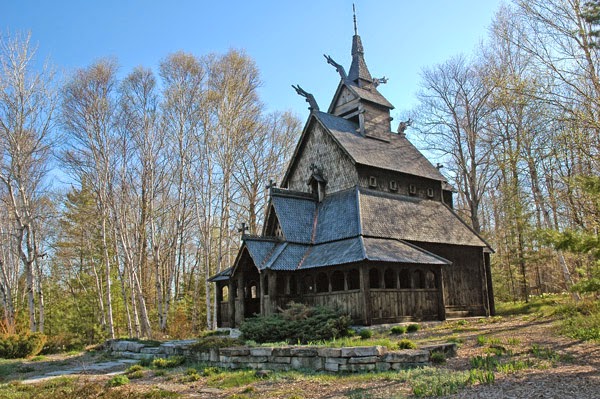
Earlier in the day we’d gotten a latte at the Red Cup Coffee House, packed with newly-arrived summer residents catching up on the news and exchanging tales about winter damage to their cottages and houses. From there we stopped in at the beautiful Stavkirke, a full-sized replica of a medieval Norwegian church tucked into the woods amid the daffodils, alongside a Nature Conservancy parcel.  


But much of Washington Island’s interior—fields or woods—is pleasantly nondescript. For tourists like us, the chief sights, aside from the stave church, are the curious Jacobsen Historical Museum, Jackson Harbor (with its marine museum), Schoolhouse Beach (with its stunning white rocks), and the local craft shop (with its subtle rag rugs and Cherokee baskets).


We visited them all, and we still had plenty of time to sit around in Adirondack chairs at the Sunset Resort where we were staying, staring out at Green Bay as the sun dropped toward the horizon. The air temperature was perfect. Some gulls squawk at one another as they fly back and forth from the low-slung islands extending northward from the tip of Figenschau Bay.

  
A slight breeze. Two foreign flags flapping—a blue cross on red, and a red cross on blue. I suppose I ought to know what they are but I don’t. 

Many of Washington Island’s first European settlers were Icelandic. That might be a good first guess?

Sunday, June 1, 2014

Door County Weekend


I suspect that for many Minnesotans, Door County seems too far away for a weekend trip, not exotic enough for an extended vacation, and likely to be overcrowded with tourists from Milwaukee and Chicago during the summer months. On the other hand,  with 300 miles of Great Lakes shoreline, five state parks, a landscape rich in ethnic enclaves and maritime lore, and numerous obscure nature preserves and sanctuaries, it seems like a place one ought to get to know.

We spent three days in Door County recently, on the tag end of a driving trip across central Wisconsin that also included Necedah National Wildlife Refuge, Horicon Marsh, Kettle-Moraine State Forest, Milwaukee, and Steven’s Point.

Our timing was impeccable: the warblers were passing through but the Memorial Day tourists had not yet arrived. We approached from the south along the coast, paying a brief visit to Sheboygan’s refurbished river harbor and whisking through Manitowoc. Our first extended stop was the Hamilton Wooden Type Museum in nearby Two Rivers.

This is the kind of museum that really ought not to exist. Wooden type is a technological dinosaur, of course. What’s the point of mounting a permanent display of outmoded Xs and Ps, of maple logs, huge saws, platen presses, and even linotype machines, in an abandoned warehouse with a leaky roof out in the middle of nowhere?

Anyone who likes literature, printing, hand-made paper, and classic type fonts will understand.  


Jim Moran, the museum director, gave us a tour of the building. He perked up when I mentioned the Minnesota Center for Book Arts.  His brother, Bill, is a professor of printing history at the University of Minnesota, and the family’s involvement in the printing industry extends back for generations.

We wandered the back rooms for a while, then took a spin around the gift shop, where various broadsides were on display. The shop’s proprietress, Mari Dawson, explained how she arrived in Two Rivers from Iowa City and places even further south,  and described what a waysgoose is. It made me want to attend one, though the last piece of cold type printing I did was in 1980—a rather dull broadside listing the twelve best sayings (or so I thought at the time) of the Greek philosopher Heraclitus.

There were very few genuine books for sale in the shop. We bought a colorful poster done by master printer  Rick Von Holdt in 2009 to commemorate the museum’s tenth anniversary.

From Two Rivers we continued north to Algoma—one of many small, tidy Wisconsin towns that still look vaguely robust and lived-in—then followed county roads S and U into Sturgeon Bay. A half-hour later we were puttering through Peninsula State Park, looking for a place to camp.

The park has 460-odd campsite in four widely-spaced campgrounds, and it took us quite a while to settle on the perfect site, in an otherwise deserted loop overlooking Nicolet Bay. We got back to pay the fee—the office was closed—only to discover a list of numbers indicating the thirty sites in the park that were considered “open.” Ours wasn’t one of them. There was no map indicating where the "open" sites were located, however, and the sun was getting low; we decided to pay the $15 camping fee, return to our Shangri-La,  and take our chances. 


We had eaten our dinner and were sitting around the fire listening to an extremely loud frog trill from high in a tree behind our tent when the ranger arrived, on foot, flashing her flashlight through the dark.

“This loop is closed,” she said, in a measured tone of voice, though she immediately added, “I’m not going to make you move. That would be stupid.”

“Thank you very much,” I replied, perhaps a little obsequiously, resisting the temptation to add, “If it’s closed, why is the entry gate open?”

We chatted for quite a while about the upcoming holiday crowd, and about “enforcement.” It was pretty obvious she enjoyed rescuing elderly hikers who were suffering from heat-stroke, though perhaps she took greater pleasure in breaking up college beer parties at 3 AM. She told us her previous position at Lake Wissota State Park, near Eau Claire, had been pretty dull.

We asked her about the frog we’d been listening to—it had long since gone silent—but she had no idea what it was.

The next morning the air was full of newly-hatched mayflies. We followed the Shore Road back to the park entrance, spotted a scarlet tanager at Weborg Point, and also--even more thrilling at me--a solitary sandpiper in the grass nearby. This is far from being a rare bird, but the specimen I saw was dazzling as it poked around in the grasses in the shadows of a spruce tree hear shore.

We rode the Sunset Bike Loop through the woods to the nature center (closed) and back. It’s a lovely loop, passing beneath towering limestone cliffs and punctuated by hills and turns, but it’s narrow and I suspect it can be treacherous in the summertime when heavily used. (We passed no one during our circuit.)

Just as were we loading the bikes back onto the car, I heard a bird call I didn’t recognize. It was like the lazy, five-note buzzing call of the black-throated green warbler, but it only had four notes, even lazier and less precisely duplicated. I found the bird. I saw the black throat, but not the slightest hint of yellow anywhere. White chip on the wing. Dark blue on top, more difficult to get a good look at from below. We both watched it for several minutes. It was a black-throated blue warbler!


The last one I saw locally was thirty-five years ago in Gooseberry State Park. (We saw two recently on the Blue Ridge Parkway in North Carolina, where I imagine they’re more common.)

We told the naturalist at the Park office, expecting she’d say, “Yes, they’re around here,” or some such lukewarm response. But no.

 “Where did you see it? I’ve only seen one in my life.”