Tuesday, June 24, 2014

Chef: The Film


 It’s one of those “small” films with stock characters, predictable plot points, and middle-aged stars in cameo roles, but it’s also a lot of fun. Jon Favreau (known to me as the director of Iron Man and Iron Man 2) wrote the script and takes the leading role, of a good-natured but hot-headed L.A. chef struggling with the tedium of producing the same restaurant menu night after night. 

When word gets around that the city’s leading food critic (Oliver Platt) will be stopping by for dinner—a critic who was instrumental in launching the chef’s career a decade earlier—Favreau buys the ingredients for an innovative menu, but the restaurant owner (Dustin Hoffman) puts the kibosh on his plans. “We’ve cooked the same menu for ten years and our patrons love it, and we will continue to cook it,” Hoffman asserts, in that tight-cheeked, nasal tone at which he is adept, while slamming a clipboard against the industrial kitchen counter.


Meanwhile, Favreau, who’s divorced, is also struggling to be a good dad to his quiet son, Percy,  in the midst of the demands and distractions of the restaurant business. The fable-like quality of the tale is made evident by the fact that Favreau’s ex is played by Columbian supermodel Sophia Vergara, and his head waitress by Scarlett Johansson. It’s bolstered further by the fact that Vergara lives in a palatial estate, courtesy of the divorce settlement with her first husband (Robert Downey, Jr.).

The plot’s catalyst is Twitter. Favreau doesn’t know what it is. Percy shows him how it works, and Favreau immediately (though inadvertently) gets into a flame war with the food critic (who, I hardly need to mention, was not impressed with his recent meal).

In the early stretches of the film, Vergara urges her ex-husband (with whom she’s on extremely cordial terms) to quit his job and return to his roots as a food truck impresario. So I won’t be giving away much  if I reveal that the second half of the film takes a turn in this direction.


There are plenty of luscious cooking scenes at the L.A. restaurant early on, and also at Favreau's bachelor apartment. There are more later, as Favreau and his old sidekick Martin ( John Leguizamo) put some spit and polish on a dilapidated food truck and drive it from Miami back to L.A., winning new fans all along the way with the help of their Twitter-savvy publicist, son Percy.

Chef is all in good fun, buoyed by a cheery energy and a palpable love of food. But if you do happen to see it, be forewarned: you’ll leave the theater wishing there was someplace nearby to pick up a good Cubano. (Manny’s Tortas at Mid-Town Market?)

*  *  *

Yes, Chef is a summer romp of a film, but it also raises an interesting question about restaurants: Is Hoffman right to demand a crowd-pleasing menu at the expense of Favreau’s “creativity” as a chef and his desire to shine in the industry? I would say yes. There is something deceptive, if not unethical, about preparing a special meal for a critic, who will then write about it favorably to countless readers, unless the restaurant plans to offer that same menu regularly. On the other hand, if a restaurant changes its menu seasonally, the chef and his (or her) staff would be less likely to get bored, and the owner would be comfortable with occasional changes to the menu. 

But then there wouldn’t be much of a film.

Tuesday, June 17, 2014

A Little Northern Spark


We lost power at about 7:30 p.m. It was as if the gods were telling us—yes, you must go down to Northern Spark! But if that was the message, then why all the rain?

With a few candles placed here and there and with headlamps strapped to our foreheads, we sat in the living room reading as the trees watusied outside the window. At 8 p.m. it started to rain hard. But at 8:30 it eased off again. The sky grew lighter. At 8:45 we said, “What the heck!”

Fifteen minutes later we were parked under the freeway just west of the Basilica of St. Mary. We walked across the small park in front of the church, made a dash across Hennepin Avenue, and entered the On Being store front where Krista Tippett runs her radio show. (I don’t really know what goes on there, but she has something to do with it.)

The gods were with us once again. No sooner had we entered the room that we spied our friend Margaret gesturing at us from the front row of seats. We hesitated—she didn’t know we were coming and obviously wasn’t saving those seats for us—but then we sat down next to her. A few feet in front of us a barefoot dancer in a green and gold dress was painting a simple but elegant floral design on the floor with white powder.

I was amazed by her ability to create a perfect arc, again and again, and I said to myself: I think she’s done this before.

Then a second woman stepped up to the microphone and read a few lines from a poem by Rabindranath Tagore about the earth. I had a hard time following it. It wasn’t complicated or obscure, but there were people talking in the hall behind us, others were coming in the door a few feet to her left, the rain was still coming down outside, and cars were passing by.

The wall to our right was filled with books to a height of eighteen feet.

Then the music started. And the dancing. Three women moved back and forth ten feet in front of us, making distinctive hand poses, squatting, extending their arms and legs as bells jingled on their anklet’s. Two of the women reminded me, not of India, but of Crete. The third had a pleasantly cherubic face. The foot-stomping occasionally brought flamenco to mind, but for the most part, the dancing was much more formal and precise, like an Egyptian hieroglyphic in motion. As if they were telling us a story in a language we couldn’t understand.

There were no slow passages, nor were there frenzied interludes. A premium was being placed on grace and body control. Yet a sense of the loveliness of the female form, and what it could do, shone forth with every gesture, every head-bob and foot-stomp and glance. This, perhaps, was what the poetry had been about.

In the course of their dance the women obliterated the ornate designs (called kolums) they’d drawn on the floor. When the piece came to an end, the creative directors of Ragamala, Ranee Ramaswamy and her daughter Aparna, explained the function of these kolums in village life as a means of greeting the day, honoring the goddesses of prosperity, and inviting them into the house. They also briefly explained what a few of the gestures mean and how they relate to village life in India today, and also as depicted in the art of the Warli, a tribe from southwestern India who have been painting murals along the same lines for upward of two thousand years. One such mural, painted by a Warli artist invited to the United States by the Ramaswamys for precisely that purpose, was hanging on the wall to the left of the stage.

 I know next to nothing about Indian culture, as you can probably tell, but the dancing reminded me of the frescos at Knossos and the footwork of Carmen Amaya and Christina Hoyos. The rain outside the window reminded me of the scene in the film Lagaan when the monsoon comes and everyone rejoices. And to my mind, the half-hour length of the program was perfect.  

After chatting for a while with Margaret, her husband, Dave, and their two late-arriving friends, who had just returned from a four-month educational cruise around the world,  we drifted out into the night, heading south toward Loring Park.

Rain or shine, this is the prettiest block in Minneapolis. It’s triangular, it has the Basilica to its north, a wonderful urban park to its south, a nice alley running down the middle of it—and the buildings themselves look like they belong in Paris.

A rock band was setting up in the first bar we passed. Next door, in Spyder Trap, a web design firm, two kids in their twenties were being filmed as they zoomed around on scooters.

Bar Lurcat was elegant and largely empty, like a scene from Midnight in Paris. People were out on the street or hanging from doorways, not because of Northern Spark, but because that’s what goes on down on Harmon Place every night.


We were headed for Luna Lux, a letterpress printing outfit. They were giving demonstrations and handing out miniature posters.

“Have you ever been to the Hamilton Wooden Type Museum in Two Rivers, Wisconsin?” I asked the woman who was pulling a little poster for us.

“I love that place,” she replied. “In fact, the director, Jim Moran, will be here in an hour. We all love Jim. His family has been in the business for centuries.”

From there we were faced with the choice of heading south across the park to the Walker Art Center, where literary folk recruited by Rain Taxi were offering to write you a personalize poem based on a Tarot layout, or proceed east, deeper into the city. Choosing the later alternative, we hoofed the quite streets for seven blocks to the plaza in front of Orchestra Hall, where a crowd had gathered.


The food trucks looked enticing but we prudently went inside and found two seats in the performance hall. The orchestra was already deep into Kevin Puts’s Symphony #4, and the sound was immense. I had forgotten how much fuller, richer, and, well, more impressive the Minnesota Orchestra is than its cousin across the river.


It took me a while to register the fact that a light-show was being projected onto the cubes behind the orchestra. I found these shifting images mesmerizing, then realized that they were distracting me, not from the music, but from the pleasantly random reveries that classical concerts always inspire. So I closed my eyes.


Out in the lobby after the performance (once again a perfect length at 25 minutes), we watched people form lines, touch electronic panels on the pillars, and generate digital sounds that filled the room and occasionally erupted into rock-n-roll for no apparent reason. The lobby itself, recently expanded, didn’t seem much bigger to me than the old lobby, but it’s definitely more antiseptic—not much of an improvement, perhaps, though difficult to judge in the weird blue light.

Quite a few people were dancing to a rock band playing in the new, glass-walled, annex west of the lobby. Meanwhile, the drizzle was intensifying. We bought a Thai pasty at Potter’s Pasties food truck--0h, that was good, what with the ginger and the sweet potatoes--and headed east for a few blocks toward the convention center plaza where Zeitgeist was due to perform at 11. (Incidentally, the festival goes on all night long.)

Then we turned around. We were getting wet. 

By the time we got to Hennepin Avenue the drizzle had turned into a deluge; we were soaked by the time we got back to the car.


Hilary (the goddess of endless energy) was eager to move on to the events down on the riverfront, or at least pay Northrup Auditorium a visit to hear the gamelan orchestra or perhaps a half-hour of Eric Satie's short and extremely repetitive piano piece, "Vexations," which was scheduled to be played ad nauseam throughout the night (just as the composer intended). I dutifully drove down Hennepin Avenue, where neon lights glowed in the rain and large crowds of people (most of whom, I’m sure, had never heard of Northern Spark) hugged the sidewalks, clustered under the theater marquees, and dashed in and out of bars and restaurants. 

It took a long time to get to the river, which looked pretty quiet. Suddenly the idea continuing on to the university campus,  parking at a ramp, and racing through the rain to Northrup, just didn’t seem that appealing to me. It was time to go home.

At least we’d gotten a taste of Northern Spark. And when you consider our day had also included a visit to the farmers market, a stop at the Midsummers Festival at the Swedish Institute, a few hours at the Japanese festival at Normandale Community College (where a book I worked on was being launched), and a few hours in front of the computer watching Italy defeat England in World Cup play, I think it's fair to say it had been a pretty full day. 

Tuesday, June 3, 2014

Washington Island (Door County - pt 2)


By the time we left the park it was after noon, and nearby Fish Harbor was simmering with Memorial Weekend vacationers. We crossed the peninsula to the “quiet side,” negotiating a major roadblock and following several back-country detours to avoid Jacksonport’s Maifest. The festival might have been fun, but we were on our way to The Ridges Sanctuary in Bailey’s Harbor. Here the dunes of Lake Michigan rise in a regular procession, and each brow further inland, as heavily wooded as the last, nourishes a different set of orchids and other plants.

We’d been there before, though I had no recollection of where it was located. I took a right turn on Ridges Road (makes sense?) and we followed it out along the shore to Tofts Point, where the road dead-ends.
Wrong road.


We hiked out to Toft’s Point itself, where quite a few Caspian terns were bracing themselves against a stiff wind coming in from the southeast across the vast open lake. The shoreline consisted of very flat slabs of limestone (I presume) covered here and there with a slurry of sandy muck that supported a smattering of grasses and stunted evergreens. If I had been taken there blindfolded I might guess I was standing on the shore of Hudson’s Bay.

Also growing in patches across the rocks were dwarf lake iris (evidently uncommon) and some sort of arctic phlox.

Back in the car, we returned to the highway and continued north, where we soon came to the Ridges, chatted with the man in the gift shop, and took a long walk down the cedar-covered humps that are the ancient dunes. We enjoyed it, though the only bird we saw was a great-crested flycatcher that flew out into the open above one of the sloughs dividing the ridges, posed for twenty seconds on a dead branch, then vanished again into the underbrush.   


The only thing we saw blooming during our walk was trailing arbutus. “It’s been a late spring,” the man had told us at the shop, apologetically. But we already knew that. In short, the Ridges was a bit of exercise and fresh air, but also a dud.   

Continuing north, we breezed through Sister Bay, which has some of the unbridled development that gives Door County a bad name, Ellison Bay (nicer) and Gills Rock, before arriving at the pier where the ferry departs for Washington Island. We bought tickets and got in line to wait for the 4 o’clock transit.

Another ethical dilemma: I bought tickets for a car and two passengers. But we had two bikes strapped to the back of the car. Should we have paid the additional $16 dollars to bring those bikes to the island and back?

It’s a half-hour trip, and during that time Hilary struck up a conversation with a woman who, like us, wore a pair of binoculars around her neck. She told us about the crested caracara that had been sighted on Washington Island. That’s a bird that rarely ventures farther north than Oklahoma.


We got to talking about other sightings, and when I mentioned the black-throated blue warbler, she, too, was curious. “Where did you see it?” she wanted to know. (It might still be there.) We told her, and then I mentioned the blue-winged warbler we see every spring along the same back road in Forestville State Park, in southeastern Minnesota. Then she told us about the pine warbler she sees every spring in a tree by the ferry landing. 

“I haven’t seen a pine warbler in years,” I said.

“Well, they aren’t common,” she replied reassuringly.

It was clear we weren’t chatting with an ordinary birder. The woman was an expert, a researcher, writing a book about the rough-legged hawk. She was headed to the island to lead a birding event. Her name was Sandy Petersen. She lives in Madison. Though she was a little secretive about her background, she knew an awful lot about recent controversies regarding the little islands we passed our way to Detroit Harbor. And she told us where we were most likely to see the caracara. She emphasized how important the wind direction was in determining where birds were most likely to be found on any given day. We learned later from folks on the island that she’d been the naturalist there for seventeen years.

We spent the next day and a half on Washington Island—just to see what is was like. The island is roughly 6 miles square, and you could probably drive all of the major roads that crisscross the island in an hour. There’s a harbor in the southwest where the ferry arrives, and a smaller one in the north east, where a smaller ferry takes visitors out to nearby Rock Island—now a state park with a lighthouse at the far end, closed to all vehicular traffic. The only town, Washington, is basically a collection of widely-scattered businesses stretched out for half a mile along Main Road, which runs north-south through the western third of the island.

Much of the island’s interior is given over to farms of one kind or another. Wheat was big for a few years, during an organic beer phase; a generation ago it was potatoes. Now lavender is making a run. There’s a horse farm that specializes in Scandinavian breeds. And a few fishermen still set their nets and bring in a catch daily. You can order fresh-caught whitefish or “lawyers” (eelpout) at local restaurants.


We had eelpout for lunch at KK Fiske’s, where the waitress—the owner’s niece—told us all about the local fishing industry. It didn’t take long.

There was no one else in the cafĂ© to keep the young woman busy, and Hilary said, by way of conversation “I suppose it will be getting pretty busy this weekend.”

“Oh, it’ll pick up a little bit, but it doesn’t really get busy until the end of June, when the old-folks start arriving by the busload.”

“People like us,” I laughed.

“God, no,” she replied. "I mean OLD. We get two kinds of people. We call them the newlyweds and the nearly-deads.”

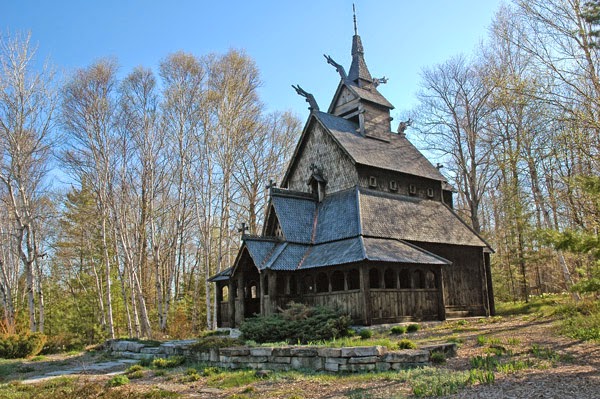
Earlier in the day we’d gotten a latte at the Red Cup Coffee House, packed with newly-arrived summer residents catching up on the news and exchanging tales about winter damage to their cottages and houses. From there we stopped in at the beautiful Stavkirke, a full-sized replica of a medieval Norwegian church tucked into the woods amid the daffodils, alongside a Nature Conservancy parcel.  


But much of Washington Island’s interior—fields or woods—is pleasantly nondescript. For tourists like us, the chief sights, aside from the stave church, are the curious Jacobsen Historical Museum, Jackson Harbor (with its marine museum), Schoolhouse Beach (with its stunning white rocks), and the local craft shop (with its subtle rag rugs and Cherokee baskets).


We visited them all, and we still had plenty of time to sit around in Adirondack chairs at the Sunset Resort where we were staying, staring out at Green Bay as the sun dropped toward the horizon. The air temperature was perfect. Some gulls squawk at one another as they fly back and forth from the low-slung islands extending northward from the tip of Figenschau Bay.

  
A slight breeze. Two foreign flags flapping—a blue cross on red, and a red cross on blue. I suppose I ought to know what they are but I don’t. 

Many of Washington Island’s first European settlers were Icelandic. That might be a good first guess?

Sunday, June 1, 2014

Door County Weekend


I suspect that for many Minnesotans, Door County seems too far away for a weekend trip, not exotic enough for an extended vacation, and likely to be overcrowded with tourists from Milwaukee and Chicago during the summer months. On the other hand,  with 300 miles of Great Lakes shoreline, five state parks, a landscape rich in ethnic enclaves and maritime lore, and numerous obscure nature preserves and sanctuaries, it seems like a place one ought to get to know.

We spent three days in Door County recently, on the tag end of a driving trip across central Wisconsin that also included Necedah National Wildlife Refuge, Horicon Marsh, Kettle-Moraine State Forest, Milwaukee, and Steven’s Point.

Our timing was impeccable: the warblers were passing through but the Memorial Day tourists had not yet arrived. We approached from the south along the coast, paying a brief visit to Sheboygan’s refurbished river harbor and whisking through Manitowoc. Our first extended stop was the Hamilton Wooden Type Museum in nearby Two Rivers.

This is the kind of museum that really ought not to exist. Wooden type is a technological dinosaur, of course. What’s the point of mounting a permanent display of outmoded Xs and Ps, of maple logs, huge saws, platen presses, and even linotype machines, in an abandoned warehouse with a leaky roof out in the middle of nowhere?

Anyone who likes literature, printing, hand-made paper, and classic type fonts will understand.  


Jim Moran, the museum director, gave us a tour of the building. He perked up when I mentioned the Minnesota Center for Book Arts.  His brother, Bill, is a professor of printing history at the University of Minnesota, and the family’s involvement in the printing industry extends back for generations.

We wandered the back rooms for a while, then took a spin around the gift shop, where various broadsides were on display. The shop’s proprietress, Mari Dawson, explained how she arrived in Two Rivers from Iowa City and places even further south,  and described what a waysgoose is. It made me want to attend one, though the last piece of cold type printing I did was in 1980—a rather dull broadside listing the twelve best sayings (or so I thought at the time) of the Greek philosopher Heraclitus.

There were very few genuine books for sale in the shop. We bought a colorful poster done by master printer  Rick Von Holdt in 2009 to commemorate the museum’s tenth anniversary.

From Two Rivers we continued north to Algoma—one of many small, tidy Wisconsin towns that still look vaguely robust and lived-in—then followed county roads S and U into Sturgeon Bay. A half-hour later we were puttering through Peninsula State Park, looking for a place to camp.

The park has 460-odd campsite in four widely-spaced campgrounds, and it took us quite a while to settle on the perfect site, in an otherwise deserted loop overlooking Nicolet Bay. We got back to pay the fee—the office was closed—only to discover a list of numbers indicating the thirty sites in the park that were considered “open.” Ours wasn’t one of them. There was no map indicating where the "open" sites were located, however, and the sun was getting low; we decided to pay the $15 camping fee, return to our Shangri-La,  and take our chances. 


We had eaten our dinner and were sitting around the fire listening to an extremely loud frog trill from high in a tree behind our tent when the ranger arrived, on foot, flashing her flashlight through the dark.

“This loop is closed,” she said, in a measured tone of voice, though she immediately added, “I’m not going to make you move. That would be stupid.”

“Thank you very much,” I replied, perhaps a little obsequiously, resisting the temptation to add, “If it’s closed, why is the entry gate open?”

We chatted for quite a while about the upcoming holiday crowd, and about “enforcement.” It was pretty obvious she enjoyed rescuing elderly hikers who were suffering from heat-stroke, though perhaps she took greater pleasure in breaking up college beer parties at 3 AM. She told us her previous position at Lake Wissota State Park, near Eau Claire, had been pretty dull.

We asked her about the frog we’d been listening to—it had long since gone silent—but she had no idea what it was.

The next morning the air was full of newly-hatched mayflies. We followed the Shore Road back to the park entrance, spotted a scarlet tanager at Weborg Point, and also--even more thrilling at me--a solitary sandpiper in the grass nearby. This is far from being a rare bird, but the specimen I saw was dazzling as it poked around in the grasses in the shadows of a spruce tree hear shore.

We rode the Sunset Bike Loop through the woods to the nature center (closed) and back. It’s a lovely loop, passing beneath towering limestone cliffs and punctuated by hills and turns, but it’s narrow and I suspect it can be treacherous in the summertime when heavily used. (We passed no one during our circuit.)

Just as were we loading the bikes back onto the car, I heard a bird call I didn’t recognize. It was like the lazy, five-note buzzing call of the black-throated green warbler, but it only had four notes, even lazier and less precisely duplicated. I found the bird. I saw the black throat, but not the slightest hint of yellow anywhere. White chip on the wing. Dark blue on top, more difficult to get a good look at from below. We both watched it for several minutes. It was a black-throated blue warbler!


The last one I saw locally was thirty-five years ago in Gooseberry State Park. (We saw two recently on the Blue Ridge Parkway in North Carolina, where I imagine they’re more common.)

We told the naturalist at the Park office, expecting she’d say, “Yes, they’re around here,” or some such lukewarm response. But no.

 “Where did you see it? I’ve only seen one in my life.”

Tuesday, May 27, 2014

Wandering Milwaukee


Cities are intrinsically cool. Why? Because there are people scurrying hither and yon who live there, amid tall buildings, traffic, energy, restaurants, and history. We relish dynamism and bigness, diversity, style, and the occult. Blade Runner and the Emerald City meet, and let’s face it, you’re not in Kansas anymore, not at work, but hoofing around in some glamorous place where deals are done, money is spent, drinks are drunk… Some effort has been made to beautify, generate an ethos, create an impression.

Glamorous? Milwaukee?

We went to find out.   

It’s hard to judge the size or “weight” of a city at first glance. Looking at Milwaukee, with its East and its West, I was immediately convinced that it’s bigger than Minneapolis. But that isn’t true. (I was surprised to read later, online, that Minneapolis ranks fifth in the US in skyscrapers, after New York, Chicago, LA, San Francisco, Seattle, Houston, and a few other towns… So much for the internet.)

What Milwaukee has that Minneapolis doesn’t have is wide, beautiful boulevards.  It also has a Great Lake to look out on. It has an intimate river snaking through it (unlike the mighty Mississippi) and a warehouse district (the historic Third Ward) that retains vestiges of its blue collar roots.

There is little point in pursuing a comparison between the two cities, which probably don’t have much in common, and don’t want to. The point is that if you’re from Minneapolis, you can have some fun wandering Milwaukee for a few hours.


We had the good fortune to book a room in the cozy County Clare Inn a few blocks west of the big lake, a few blocks north of the Milwaukee Art Museum. This room was considerably above our standard, with 13-foot ceilings and a whirlpool bath. But with two nights of camping and a Priceline motel deal behind us, we were still on budget. Throw in free parking and a breakfast omelet made by a mustachioed gentleman with a French accent, and who’s complaining?

After admiring the statue in Juneau Park and glancing down the hill at Lake Michigan and the striking metal “wings” in front of the art museum, we headed up Wisconsin Avenue.


This is a very fine street, hardly marred by the fact that the world’s ugliest building, The US Bank Building, faces it from the south.

This building was designed by the Bengali architect Fazlur Rahman Khan, the “father” of tubular construction—a  method that has made possible an entire generation of ugly but very tall buildings, including the Sears Tower in Chicago. Looking at the US Bank building reminds one of Filene’s Basement—cookie-cutter functional cross-bracing without a hint of aesthetic appeal. (The John Hancock Building ain’t so great, either.)

The nearby Wells Fargo building, though it carries a whiff of Phillip Johnson-esque pre-post-modern historical allusion, is fairly handsome, and to some natives it might even call to mind the 14-story Pabst “skyscraper” that previously stood on the same spot.


But the main thing about Wisconsin Avenue is how wonderfully wide it is. It’s almost a boulevard. It might even have flowering trees. There are other interesting buildings here and there, but the overall tone is historic and even genteel, rather than fast-paced or futuristic. It’s a nice street. One you want to walk down.

Then you come to the Milwaukee River, which has been made into a Riverwalk. It seems they’re still working on that. Construction everywhere. Many sidewalks and restaurants closed. But if you head south along the river and dip under the freeway, weaving and bobbing your way on foot, you’ll come at last to the Historic Third Ward, anchored by the Milwaukee Public Market.


This building houses a number of festive food stalls, which will remind some visitors of the Grand Central Market in Los Angeles or the West Side Market in Cleveland, though on a much smaller scale. It’s a great lunch stop—no doubt about that.


A few blocks west through some handsome warehouse structures will lead you to the river again, where half-empty tour boats take conventioneers downstream or upstream past breweries beyond number. It’s all in good fun.


We wandered upstream to the park where Father Jacques Marquette may have camped for four night in the early 1670’s.(If you've read the Jesuit Relations from the period, or even Francis Parkman's synopsis of the era, you'll know how far mosquito control has advanced since those times.) 

We were camping on the Rock River two nights earlier, just south of Horicon Marsh, where Indians had camps for countless generations. The frogs were peeping, and as we sat by the fire, Hilary spotted a great horned owl drop down into the trees on the far side of the river. It delivered its five-note hoot, and I could see its white necklace with binoculars in the dim evening light.

We should have gone into the elegant, triangular Wisconsin Historical Society building near the park, but we really didn’t want to look at exhibits. We were heading for the Turner Hall a few blocks away, past a street or two of slightly run-down German restaurants.


The Hall was closed, though we wandered upstairs as far as we could, and saw the famous beer stein collection through the glass in the bar. Such Old World associations are kind of corny, but they’re also cool, especially when you consider that the Public Market is brand new, and Pere Marquette Park was called Zeidler Union Square a mere fifty years ago. The Turner Hall has been going strong since 1883, and in various ways its gymnasium, beer hall, meeting rooms, and two-story ballroom continue to promote the Turner ideal of a sound mind and a sound body—through exercise, right reason, and beer.


After a restorative Starbucks coffee, we headed back down to the art museum on the waterfront. I found the Calatrava entry and foyer to be antiseptic—exactly what fine art shouldn’t be. I tried my best to get the receptionist to let us in on the strength of our Minneapolis Art Institute membership—reciprocity and all that—but she utterly failed to rise to the occasion. So we saved $34 and walked around the front of the building, then up the hill through the nice grass, then down the street to our lovely inn.

The evening light was golden. From the restaurant we watched people pass riding mountain bikes, carrying yoga mats. (Gone are the days of the boom-box, perhaps.) The corned beef and cabbage was far inferior to what my mother (nee McIlvenna) used to make, but it was good enough.


One last wander through the neighborhood. We're looking forward to a bike ride along the coast in the morning.        

Sunday, May 11, 2014

Spring Warbler Migration - Wood Lake


For many birders, the arrival of the warblers every spring is the peak of the birding year. Colorful and diverse, but also tiny and often very active amid the higher branches, many warblers remain elusive, and often difficult to identify. They’re also fleeting. Their arrival is their departure, to a large degree. Many species are just passing through on their way to nesting grounds further north.

The myrtle warbler is the first to arrive, and they’ve been in the Twin Cities for several weeks now at least. It’s easy to admire the first three or four you see, but they soon become so numerous that the thrill palls. All the same, I saw one this morning that was dazzling; the light must have been just right.

This morning Hilary and I ventured down to Wood Lake Nature Preserve in Richfield, to see if the broader migration of warblers had gotten underway in earnest. It has.


We were hardly inside the gate when Hil spotted a black-and-white climbing zig-zag fashion up the thick bark of a cottonwood tree. Not long afterward we saw our first yellow warbler (pictured above). Bright yellow with beady black eye and subtle orange stripes on the chest. Yellow warblers tend to look youthful and energetic. I might even go so far as to call them “dashing.”

As we made our way around the north east end of the lake other species made their appearance one by one. They weren’t present in floods, like they are in some years. But one or two is plenty, especially if you get a good look. We came upon a common yellowthroat amid the cattails, redstarts here and there, and a chestnut-sided warbler off in the southeast corner of the park where the touch-and-smell trail for the seeing impaired used to be.  

I heard five or six northern parulas and spotted one high up in a poplar. Well, it wasn’t an exceptional sighting. Perhaps our most unusual sighting was of a Canada warbler, with his yellow chest and pale black necklace. The best sighting—fantastic bird, fantatic view—was of a magnolia warbler, which is a sort of super-myrtle, with yellow chest, mask, black necklace, broad white wing-bar, and white band on the underside of the trail.


Though the warblers were the main attraction, there were other new arrivals, too. The Baltimore orioles were everywhere, singing their honeyed songs. And we also got a very good look at a blue-headed vireo. We were approaching the visitors’ center on our way back to the car when I spotted a nondescript warbler-like bird poking around in the dirt on the side of the path. The coloration was obvious—green-gray back, grayish underside, faint line across the eye. But the name didn’t come. And then it did.

I don’t want to keep you guessing. It was a Tennessee warbler. In the gray morning light the colors were more vivid than normal, which had me fooled…and you don’t often see them on the ground.

On our little morning escapade we’d netted perhaps a fifth of the warblers we might possibly have seen. That’s not bad for an hour walk in the woods.


A brief visit to Hyland Park Reserve in early afternoon was quieter, though we did come upon three palm warblers on the path in front of the nature center. On our way home we pulled into the parking lot at Hyland Lake on a whim, and almost immediately came upon a beautiful Nashville warbler in a small tree at eye level. That perfect eye-ring! And a wonderful transition from greenish back to gray head, terminating abruptly at the white “chin.”

We took a short stroll along the lake, vowing to return on another occasion to explore the other side of the park, which is tucked up against the ski hills. We climbed to a ridge and on the way back down to the parking lot had one final surprise—a blue-gray gnatcatcher!


Monday, May 5, 2014

Finding Vivian Meiers


 Nearly everyone takes photographs. But they’re usually of the kids’ birthday parties, summer vacations at the lake, sunlit frost on the trees—and more recently, the Rueben sandwich you were served at the Modern Times CafĂ© yesterday. Vivian Meiers, a reclusive Chicago nanny, took roughly a roll of film every day for decades, though she developed very few of the negatives. They turned out to be more interesting.


In 2009, a young man named John Maloof bought a case of the recently deceased and entirely unknown woman’s negatives at auction for $384, hoping that the Chicago street scenes would be a useful complement to a local history he was writing. Taking a closer look, he became convinced that Vivian Meiers was a great photographer, worthy of being mentioned in the same breath as Atget, Carier-Bresson, Robert Frank, or Diane Arbus. He presents his case in the documentary Finding Vivian Meiers.  I, for one, am convinced.


The film consists of interviews with the various wealthy families that employed Meiers at one time or another, and the children (now adults) who were in her care. Famous photographers on the order of Joel Meyerowitz also receive extended screen time. Maloof tells us how he acquired the material, the steps he took to research Meier’s family and her years spent with relatives in France, and the difficulties he encountered interesting leading photography curators in Meier’s work.


Interspersed throughout the narrative are stills Meier took on the streets of Chicago, remarkable for their balance, oddness, handling of light and dark, and warmth. Meier isn’t trying to deliver a harsh critique of the alienation of modern urban life or take us beyond what photographers have done before. Rather, she’s picking up on the beauty and particularity of individual moments, individual lives.


As the film progresses, the talking points are several. Did Meiers know she was great? Did she care? Is that what we should worry ourselves about—her stature? Or is it enough to see life with renewed freshness through the eyes of an “unknown craftsman."?

Would she be happy to know she's finally getting a degree of recognition? Would she care? Or was it enough to see and admire and capture a thousand little moments, drawing out the flickers of genius in others many of whom were starring in their own little dramas, unknown to the world, unrecognized?

The Minneapolis Photo Center had a show of Vivian Meier's work recently, and it was so popular they now have a permanent exhibit of her work on display.